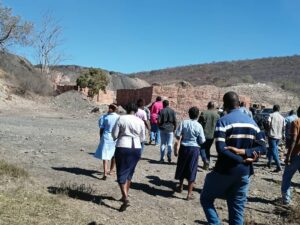
Matetsi – Private conservancies are halting the decline of biodiversity in Matetsi, a popular destination for hunting and safari tourists. Landowners are collaborating to preserve these private conservancies and lessen losses from fire damage by forming strategic committees and installing fireguards.
The country’s three main forest ecosystems are Mopane (which makes up 45% of the total forest cover), Miombo (30%), and Baikiaea (25%). The Matetsi region is primarily covered by Miombo woods, which are found throughout the country’s eastern and northern regions.
The proprietors hire people from neighboring areas to help with labor to preserve the forests, which are home to flourishing flora and fauna. According to wildlife conservancy owner Christopher Ncube, trees provide as habitat for wildlife and must be preserved to preserve natural ecosystems.
“In previous years, veld fires destroyed many of our cherished woodlands. Standard fireguards are one of the options we developed together at that point. When we had them before, they weren’t very good,” Ncube stated.
About 49% of Zimbabwe’s 390 000 km2 total land area is covered by forests. There are 532 bird species, 270 mammal species, and 4440 plant species listed by the World Wildlife Foundation (WWF).
Located in the Hwange region of Matabeleland North, in the northwest of Zimbabwe, Matetsi is home to several wildlife safaris and shares borders with Hwange, Zambezi, and Victoria Falls National Parks. When poachers were hunting, they sparked most of the veld fires that have been documented in the past. Illegal charcoal production has also been connected to the veld fires in the Hwange district.
Over the past three years, veld fires have impacted an increasing number of hectares in Matabeleland North, according to the Environmental Management Agency (EMA). In 2020, there were 74 002,24 hectares burned; by 2021, that amount had increased significantly to 172 215, 01 hectares. The amount of hectares of woodland and grassland devastated by veld fires shockingly doubled to 399 6222,79 in 2022. With 88,307 hectares burned, the Hwange area is one of the province’s top fire hotspots, according to the Environmental Management Agency’s (EMA) 2022 Fire report.
The main human activities associated with land-use patterns and practices that are prone to veld fires are held accountable for the flames’ origins. Conservationists claim that increasing climate variability and the effects of climate change exacerbate the problem of veld fires. Rainfall occurs later in the season, and there are more dry spells.
David Maunze, an EMA officer in the province of Matabeleland North, is extremely concerned about the destruction of natural resources brought on by veld fires.
“Wildfires are a major threat to the environment because they cause deforestation, desertification of grasslands and forests, and land degradation,” he said.
Every year, Zimbabwe observes a fire restriction season from July 1 to November 30 and celebrates Veld Fire Awareness Week in May.
Bernard Mpofu, another private conservancy owner in Matetsi, stated that preserving biodiversity is about more than just business; it’s also about being responsible and preserving the ecosystem.
“The oxygen we need comes from these trees. So, protecting of forests is a big deal to us. We have been raised through these forests and there is need for us to make sure we keep them alive. Natural resources are national gains we must all endeavor to protect and harness for community development in a sustainable manner,” said Mpofu.
Unfortunately, the primary reasons for the nation’s notable decline in forest cover in recent decades have been overexploitation and degradation of the native forest. Global Forest Watch estimates that between 1990 and 2010, Zimbabwe lost over 6.5 million hectares of forest cover year. This is a yearly decrease of 1.48%.

To proactively protect animal areas, Matetsi landowners are taking pre-, during-, and post-suppression measures for veld fires.
“We are happy that our forests are still standing and are winning because we have adopted proper fireguards. In the case of inadequate manning, the loss is reduced by standard fire guards. You cannot rely on neighbors or bystanders, especially in these conservancies; sometimes there are none at all. Villages are separated by a great distance,” Mpofu said.
Everyone in Zimbabwe is legally obligated to help extinguish a veld fire that is within their local vicinity. However, neighbors often observe the veld fires destroying the trees or the hamlet’s crops.
“As landowners, we established a committee and developed plans. One efficient strategy for preventing and putting out veld fires on farms and private conservancies is for landowners to work together in an integrated manner. There are not enough full-time employees for some of us. Thus, we help one another in the event of an outbreak,” Matetsi farmer Garikai Chimhanda said.
According to the Forestry Commission, the country loses 330,000 hectares of forest area year on average. During its Second Voluntary National Review in 2021, the United Nations growth Program (UNDP) attributed Zimbabwe’s forest decrease to invasive alien species, uncontrolled veld fires, and the growing demand for agricultural growth and human settlement. According to Luckson Zvobgo, a researcher who studies deforestation and its impact on achieving national climate change mitigation targets, Zimbabwe might lose all of its trees in 52 years.
According to Christine Munetsi, an environmentalist campaigner based in Hwange, animals, tourism, and forests are all intertwined.
“All of this is the same thing. The forest sector is essential to maintaining the country’s socioeconomic development because of these two complimentary activities. It is crucial to keep in mind that forest rents made up 4.1% of the country’s GDP in 2016. Our only option is to encourage people to extinguish veld fires and preserve biodiversity,” Munetsi continued.
The Minister of Environment and Climate Change, Mangaliso Ndlovu, claims that veld fires deprive animals and wildlife of pastures by destroying an average of one million hectares of woodland and grassland in Zimbabwe each year.
A total of 3,948 fires were documented during the dry season in 2021, burning 1,033 122ha of forest and grasslands, in contrast to 1,178 fires detected in 2020 that damaged 1,100,000 hectares of forest and grasslands. The average area burned in 2021 was 261 830 hectares less than in 2022, which was the lowest of all previous years.
Given the veld fires’ annual persistence, growth, causes, and impacts on communities and the ecology, environmentalists say it is clear that veld fire management has to be reviewed.
In order to ensure that the objectives of the National Development Strategy (NDS1) are fulfilled, the government set a minimum target last year to cut veld fire losses by 25%. The Forest Commission and the Environmental Management Agency are two important institutions that are currently leading the charge to protect biodiversity and raise awareness.
Brighton Dube, a villager in Sikabela, Matetsi area said through awareness campaigns, the community now assists conservancies owners and EMA in alerting of the poachers and other activities which can result into a fire outbreak or loss of biodiversity.
“Government representatives launched an anti-veld fire campaign here last year. We felt privileged and like we were a part of the answer, which we are,” Dube remarked.
According to Global Forest Watch research on Zimbabwe, the Miombo and Baikiaea ecosystems’ forest cover will have sharply declined to 10% and 18.5%, respectively, by 2050. By 2050, it is projected that mopane woodlands will have expanded to 70%.