
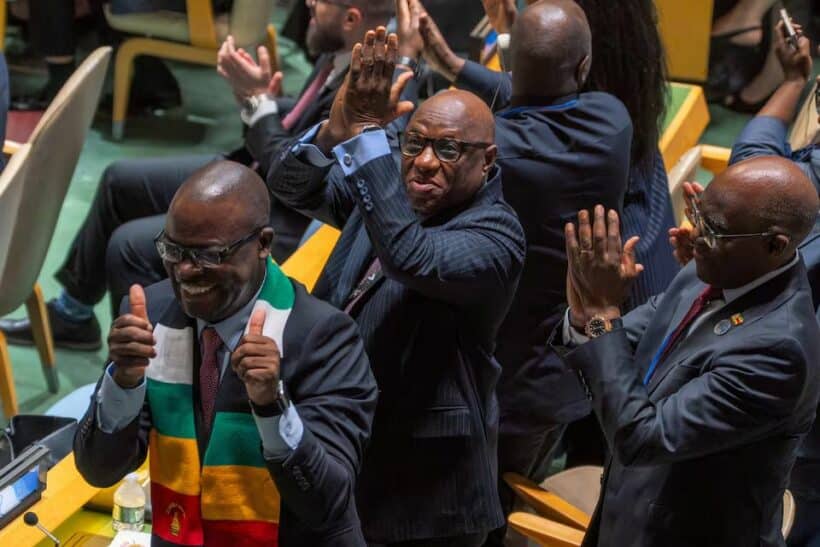
Zimbabwe's Foreign Affairs and International Trade Minister thumps up the delegates in New York after election to the UN Security Council
HARARE – Zimbabwe has been elected as a non-permanent member of the United Nations Security Council (UNSC) for the 2027–2028 term, marking one of the country’s most significant diplomatic achievements in recent years and giving it a seat at the world’s most powerful decision-making body on international peace and security.
The election took place at the United Nations General Assembly in New York on June 3, where member states voted to fill five non-permanent seats on the 15-member Security Council. Zimbabwe secured the African Group seat and will serve alongside Austria, Kyrgyzstan, Portugal, and Trinidad and Tobago from January 1, 2027, until December 31, 2028.
The Security Council is the only UN organ with the authority to adopt legally binding resolutions on international peace and security, including imposing sanctions, authorising peacekeeping missions, and approving the use of force under international law. The council comprises five permanent members – the United States, China, Russia, France, and the United Kingdom, and ten non-permanent members elected for two-year terms.
Zimbabwe’s election follows a diplomatic campaign launched several years ago and supported by regional and international partners. The country’s candidacy received backing from the Southern African Development Community (SADC), the African Union and several countries that publicly endorsed Harare’s bid.
The victory is being viewed as a major boost for Zimbabwe’s international standing. For decades, the country has sought to strengthen its engagement with multilateral institutions and expand its role in global affairs. Occupying a seat on the Security Council will provide Zimbabwe with a platform to contribute directly to discussions on conflicts, peacekeeping operations, terrorism, sanctions regimes, and other matters affecting international security.
Analysts say the election reflects growing confidence among UN member states in Zimbabwe’s ability to participate in international diplomacy despite continuing debates over governance and human rights issues at home. The Security Council seat places Zimbabwe among a select group of nations entrusted with helping shape responses to some of the world’s most pressing crises.
The timing of Zimbabwe’s election is significant. The incoming council will begin its work at a moment of heightened global tensions, with ongoing conflicts in several regions, growing geopolitical competition among major powers, and increasing concern over issues such as terrorism, climate-related security risks, and humanitarian emergencies. Experts expect elected members of the council to play an increasingly important role in building consensus amid divisions among the permanent members.
For Zimbabwe, the seat offers several potential benefits.
First, it provides an opportunity to amplify African perspectives on international security matters. African countries frequently argue that the continent remains underrepresented in global governance structures despite accounting for a significant portion of issues discussed by the Security Council. Zimbabwe is expected to work closely with fellow African members and regional organisations to promote African positions on peace and security challenges.
Second, the position could enhance Zimbabwe’s diplomatic profile. Membership of the Security Council often increases a country’s visibility and influence within the international system, creating opportunities for deeper engagement with major powers, multilateral institutions, and development partners. Zimbabwe may use the platform to strengthen bilateral relations and advance its foreign policy objectives.
Third, the election supports Zimbabwe’s broader efforts to re-engage with the international community. In recent years, Harare has pursued a policy aimed at improving diplomatic relations and attracting investment. A successful Security Council term could help reinforce perceptions of Zimbabwe as an active participant in multilateral diplomacy and international cooperation.
The election is also historic in the context of Zimbabwe’s foreign policy tradition. Since independence in 1980, the country has consistently advocated for multilateralism, decolonisation, sovereign equality of states, and greater representation for developing countries in global institutions. Security Council membership will provide a forum to advance those positions at the highest level of international diplomacy.
As a non-permanent member, Zimbabwe will not possess veto powers, which remain exclusively reserved for the council’s five permanent members. However, elected members often influence negotiations, draft resolutions, chair committees, and help build coalitions around key issues. In many instances, non-permanent members have played crucial roles in shaping Security Council outcomes through diplomacy and consensus-building.
The country’s election also carries symbolic importance domestically. It is likely to be presented as evidence of Zimbabwe’s growing acceptance within the international community and recognition of its role in regional and global affairs. Government officials have described the campaign as part of a broader effort to ensure Zimbabwe contributes meaningfully to global governance and international peace initiatives.
Zimbabwe will officially assume its seat on January 1, 2027, replacing Somalia as the African representative whose term concludes at the end of 2026. How effectively the country uses that platform over the next two years will be closely watched both within Africa and across the wider international community.



This was an informative and engaging article. I appreciate how it highlights the significance of Zimbabwe’s election to the UN Security Council and the potential opportunities it presents for the country’s diplomatic engagement on the global stage. Thank you for sharing this important update and providing valuable context on its international significance.