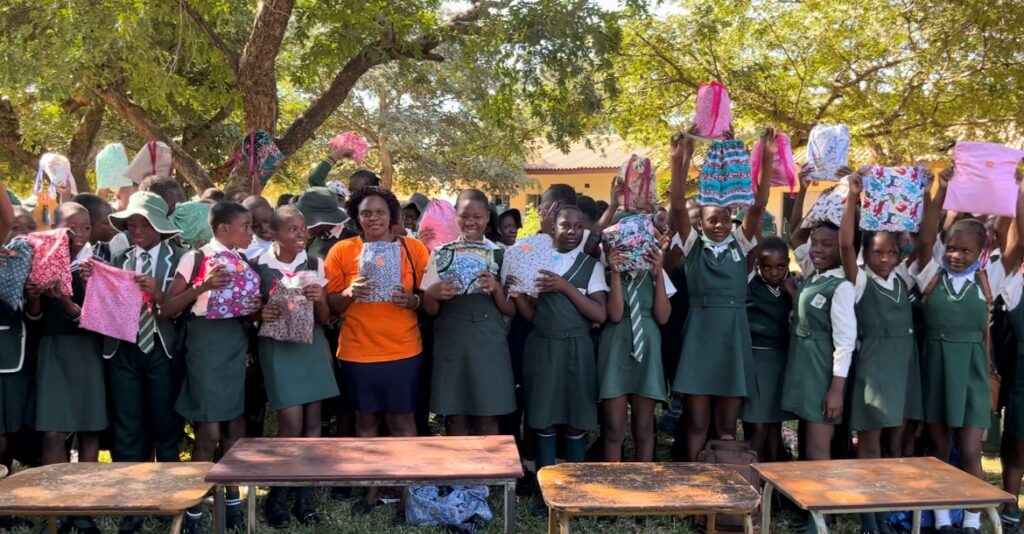
Chemabondo Grade 7 Students with reusable sanitary packs
VICTORIA FALLS, Zimbabwe – In the resort town of Victoria Falls, a primary school has for years been in the fight against pollution. The school has an international footprint for its commitment to environmental conservation. The commitment of Chamabondo Primary School’s youthful “Ozone Defenders,” a group of pupils who have made their school an example of sustainability and environmental friendliness, has drawn the attention of the UN and other international organizations.
The Ozone Defenders club was founded in 2014 and is made up of 30 to 45 motivated students in Grades 4 through 7 who are passionate about making a difference in their community and the world. These young environmentalists have started projects that address waste management, energy sustainability, and plastic pollution with the backing of committed educators and community members.
“When we stated the club, we felt responsible for our environment and we resolved that plastic pollution must be a thing of the past in our town. We also wanted to promote tourism through environmental good practises,” said Anesu Kupangwa, a former Ozone Defender Club member.
In Zimbabwe environmental pollution has been raised on several occasions. Both companies and individuals have been alleged to be perpetrators. Many efforts have been made in the field of air pollution, which is primarily emphasized because of its impacts on the ozone layer and, in turn, climate change as a result of greenhouse gas emissions. However, many involved in the battle, claim that plastic pollution is growing and poses an equivalent threat to the ecosystem as air pollution.
According to the Zimbabwe Environmental Law Association, of the waste disposed in Zimbabwe, plastic waste alone amounts to approximately 342 000 tonnes per annum, which is about 18 % of the total waste in Zimbabwe largely in the form of Low-Density Polythene (LDPE); High Density Polythene (HDPE); Polyethylene Terephthalate; Poly vinyl chloride and Polypropylene. 12 million tonnes of plastic find its way into the ocean every single year.
The Besana Mail spoke to one of the young person who has been at the forefront in the fight against plastic pollution. Alwande Sigabade Moyo serves as the Junior Senator for Khumalo Constituency in Bulawayo, and Junior Minister of Environment, Tourism, Climate and Wildlife.
“We must be cognisant of the fact that plastic takes thousands of years to degrade. Now, we as Zimbabwe are already feeling the threats and effects of plastic pollution. Some of the effects include the choking of marine life eventually leading to extinction of unique marine creatures. Even our birds are dying in their thousands,” said Moyo.
Pollutant discharge into the environment is forbidden by the Zimbabwe Environmental Management Act of 2002. According to environmentalists, this puts Zimbabwe on the correct path toward environmental justice in accordance with the “Polluter Pays” principle. An environmental regulation known as the “polluter pays principle” holds polluters accountable for the expenses of their pollution and the harm it does to the environment. The principle is a key part of sustainable development and is used to regulate pollution in the air, land, and water.
The Child minister, said his ministry action plan is very simple – “Reduce plastic, Reuse plastic, Recycle plastic, Educate, Take initiative and act now.” He advised people to desist from blame game and take accountability.
Working with his peers across the country, Moyo is proud of the ‘Ozone Defenders’ at Chamabondo primary school.
One of the most eye-catching projects initiated by the Ozone Defenders is a grass-thatched summer hut built entirely from recycled materials. Students gathered 1,800 plastic bottles from local stores and the streets to construct the hut’s walls. With guidance from the Environmental Management Agency and donations from local organizations, the club members learned to use wet sand to fill the plastic bottles, creating a solid structure for the walls. This environmentally sustainable pavilion was given a traditional touch by the National Railways of Zimbabwe, which supplied thatch grass for the roof.
Known by the students as the “recycled gazebo,” this summer house has evolved into a multipurpose area on the school’s property. During the COVID-19 epidemic, it was converted into an isolation facility for kids who may have been exposed to the virus. It also functions as a meeting spot for school clubs and a place for staff to relax.
According to Clive Ncube, an environmental campaigner in Victoria Falls, Zimbabwe suffers from water scarcity, and plastic garbage contains hazardous compounds that contaminate ground water.
“Imagine if the little water we have left being contaminated by the plastic we consume. Added to this, slowly but surely we are chasing away tourists and potential investors because of our littering and bad habits of waste disposal. These are just a few of the threats posed by plastic pollution,” said Ncube.
The government of Zimbabwe has made strides to intervene in plastic pollution. Litter crisis was declared as a state of national disaster. The Junior cabinet has drawn their own youthful version of the National Development Strategy (NDS) 1, which emphasises on caring for the environment and natural resources. Guided by this mini NDS, the junior cabinet have embarked on an extensive campaign in conjunction with Environmental Management Agency.
The mission of the Ozone Defenders is in line with Zimbabwe’s Vision 2030, which seeks to advance sustainable development in all spheres of life.
The Environmental Management Act of 2010, which focuses on the use and disposal of plastic, is provided for under Zimbabwe’s Constitution. It forbids the use of non-biodegradable plastic and polymers with wall thicknesses less than 30 micrometers.
“However, I strongly feel like we should enact more laws which curb usage of plastic,” said Khumbulani Mpako, a resident in Chinotimba, Victoria Falls.
The Ministry of Environment, Water and Climate is running a programme called ‘Catch Them Young’, targeting primary and secondary schools. The programme is an awareness, advocacy and action crusade. It has been successful and implemented throughout the country.
“Catch Them Young should visit schools more often. Litter issue is a mind-set issue and we should indeed mould these brains at a younger stage. Added to this, Junior Cabinet has made it a point to be part of the National Clean-up session every First Friday of the month and we implore all Zimbabweans to join us. Together we can!” added Child Minister Moyo.
Findings in Zimbabwe show that, the private sector and corporation discard the most plastic waste. Young people in various communities think it is also their responsibility to support programme such as Catch Them Young.
Students nationwide are exhibiting the values of environmental stewardship at an early age through recycling, waste reduction, and the production of renewable energy. The club’s influence in Victoria Falls has gone beyond the school, as it has inspired former Chamabondo students to implement environmentally friendly initiatives in their secondary schools.