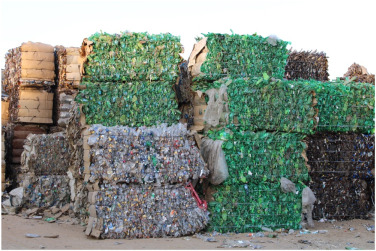
Collected PET plastic bottles
Harare, Zimbabwe — Nestled on the outskirts of Harare, a transformation is quietly taking shape. Mounds of post-consumer plastic garbage are being sorted, shredded, and melted down at a bustling factory. As the first large-scale PET (polyethylene terephthalate) recycling company in Zimbabwe, PETRECOZIM has become a key role in the country’s efforts to reduce plastic pollution by implementing the circular economy.
Plastic waste, particularly PET used in beverage bottles, has been a thorny issue in Zimbabwe’s waste management landscape. PET plastic, despite its widespread use, is infamously resistant to breakdown and frequently ends up polluting streets, clogging rivers, or even burning in uncontrolled fires, which generates harmful toxins. In response to these difficulties, PETRECOZIM, a facility in southern Harare, was established in response to these challenges with a specific goal according to the company’s inaugural Chief Operating Officer.
“To eliminate PET plastic waste in Zimbabwe by means of network cooperation, enterprise development, and sustainable recycling,” said Tawanda Masuka.
The work of PETRECOZIM explore how inter-organisational networks of bottlers, manufacturers, and brand owners have come together to foster enterprise development, address the plastic waste crisis, and chart a sustainable path forward for Zimbabwe’s circular economy.
A Growing Waste Crisis
Zimbabwe, like many other African nations, faces a mounting plastic pollution crisis. Streets, rivers, and communities are swamped with plastic trash as a result of the growing use of plastic in consumer packaging and the inadequate waste disposal infrastructure.
Environmental advocacy groups claim that because PET plastics are so durable and widely used in bottled beverages, they are one of the most pervasive types of waste
The country’s waste management systems, strained under limited resources and infrastructure, struggle to keep pace with the sheer volume of plastic waste. Landfills are reaching capacity, and municipal dumps are filled with heaps of plastic that could take centuries to degrade.
“We were quickly reaching a tipping point with plastic waste,” says Desire Nyagura, an environmental policy advocate based in Harare.
Masuka said the city of Harare was rapidly approaching a tipping point with plastic waste.
“It became clear that conventional waste management techniques by themselves wouldn’t be adequate due to the enormous amount of plastic entering the trash stream. We required creative solutions that went beyond garbage collection,” he explained.
This was the impetus behind PETRECOZIM, an ambitious collaborative project spearheaded by a network of industry players, including beverage bottlers, plastic manufacturers, and brand owners. Together, these organisations are pioneering a circular economy solution to mitigate Zimbabwe’s plastic problem while creating economic opportunities.
The Circular Economy Approach
Reusing, recycling, and remanufacturing resources and products in closed loops is the core idea of a circular economy. It challenges the traditional “take, make, dispose” model by promoting the continuous use of resources. Circularity for PETRECOZIM entails not just gathering discarded PET bottles but also turning them into reusable goods and reusing them in other supply chains.
This shift has been made possible through an innovative network-based model that pools resources, expertise, and market access among stakeholders. This model is an uncommon instance of cooperation in the typically disjointed waste management industry.
“We do more than just recycle plastic at PETRECOZIM,” Masuka states, “We are redefining waste as a resource and catalysing a change in our country’s approach to waste management. We’re making recycling economically feasible and environmentally sustainable by combining waste collection, processing, and remanufacturing into a single network.”
Collaboration in Action
PETRECOZIM’s operations hinge on partnerships across Zimbabwe’s plastic waste ecosystem. Its key stakeholders include bottling companies who contribute their used PET bottles, manufacturers who transform recycled plastic into new materials, and brand owners who integrate these materials back into their packaging.
The company has created an end-to-end recycling system through concerted efforts. After being gathered, sorted, and shred into bales and flakes, used PET bottles are converted into resins and other recycled goods. In a closed-loop system, this recycled material is used to make new bottles and other plastic products.
But the journey has not been without hurdles. According to Mike Hamandishe, an environmental researcher who has has been following closely the work, “One of the challenges is the low participation rate among some bottling companies, especially those who operate outside the PETRECOZIM network. Without a fully unified effort, there’s a risk that plastic from non-participating companies still ends up in landfills.”
As a result, the company has been aggressively enlisting new partners to broaden its network and boost the group’s recycling capacity. There are attempts to persuade these bottlers to fund recycling programs or, if feasible, switch to biodegradable substitutes.
The Economic Benefits of Circularity
Beyond reducing waste, PETRECOZIM’s circular approach offers Zimbabwe additional financial advantages. It is promoting the development of jobs throughout the supply chain by developing a closed-loop recycling system. In an environment with high unemployment rates, the PET recycling process creates job chances for everyone from waste collectors and transporters to recycling operators and factory workers.
The network’s approach not only generates employment but also promotes industry self-regulation. The cooperative network has allowed the business to continue operating without heavily depending on outside finance by sharing duties, risks, and benefits. However, experts caution that in order to encourage enterprise growth and innovation and ensure long-term survival, sustainable finance strategies are required.
According to Masuka, the firm is highly dependent on the assistance of its network members.
“Without our partners’ financial support and combined efforts, PETRECOZIM would have a difficult time surviving. To make sure we continue to be effective and operational, we are currently looking into blended funding solutions that go beyond our present network.”
Overcoming Barriers and Scaling Solutions
Even with model’s success, obstacles still exist. The business does not yet have the infrastructure to recycle more than bales and flakes, and advanced recycling equipment is expensive. This restricts its capacity to create valuable recycled goods, such food-grade packaging, which would help to further reduce PET waste.
“High-tech recycling is a huge investment,” says Masuka. “For the company to expand its capabilities, it would require technical and financial support that isn’t yet available locally. Collaboration with international partners or investors could open doors to more sophisticated recycling technologies.”
Moreover, while PETRECOZIM has demonstrated the potential for collaboration-driven recycling, the absence of comprehensive waste management legislation in Zimbabwe creates regulatory gaps. Nyagura said, a national policy supporting circular economy initiatives could drive greater participation from the private sector, which would bolster the company’s efforts and bring new stakeholders into the network.
According to Masuka, collaborations with governmental organizations may promote more stringent recycling regulations and trash separation, which would drive businesses to be more accountable for their plastic waste.
PETRECOZIM has shown that Zimbabwe’s plastic pollution crisis can be tackled through a well-coordinated circular economy model that leverages inter-organisational networks. This is more than simply an environmental solution for Zimbabwe. It is a means of achieving sustainable development, an economic necessity, and evidence of the effectiveness of networks and teamwork in tackling the most important environmental issues facing the globe.