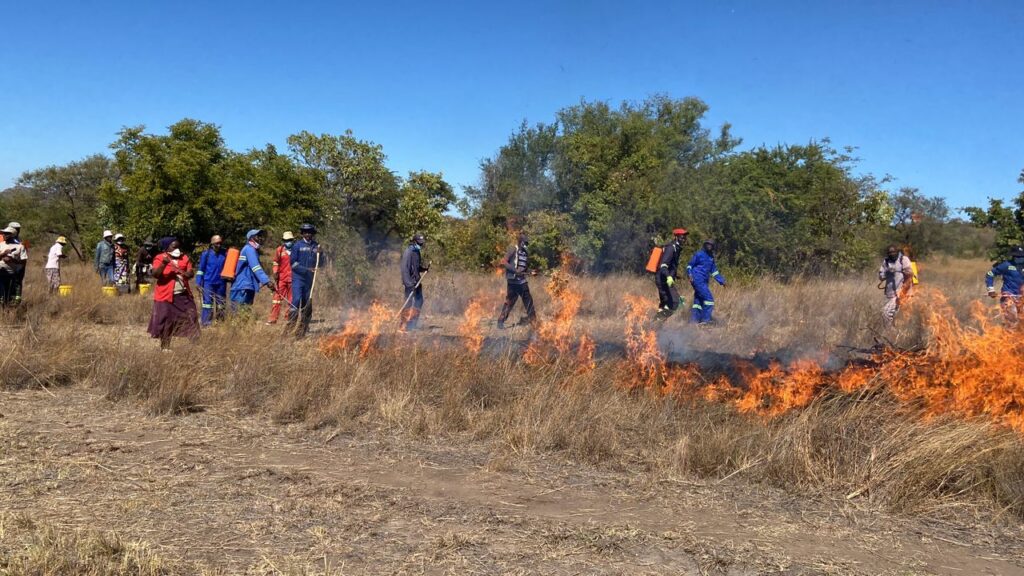
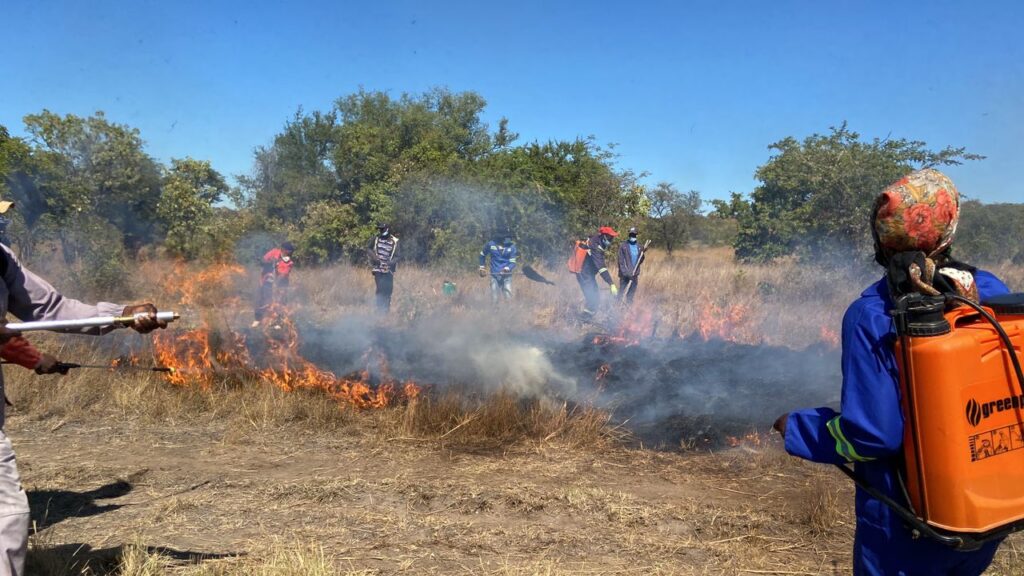
Malunga Women and other community Members during a fire demonstration - Photo Credit Eullah Ncube/Besana Mail
With each year, the country losing over a million hectares of forests and grasslands, depriving wildlife and livestock of pastures and leaving the country counting loses of property, infrastructure, crops, and human life, in Matabeleland South, women are taking the responsibility to save communities.
Eullah Ncube
Matobo – Lucy Siwa (58) is excited whenever she puts out veld fire, she took it as her biggest contribution to her community and the country. She has participated in many firefighting incidents. Lucy is part of the Malunga women, known for their bravery in fire fighting.
On 17 May 2024 during the Environmental Management Agency (EMA) provincial fire launch, Malunga women showed off their skills during a fire demonstration. They managed to put out a fire together with their male counterparts. The demonstration was to spread awareness on the dangers of veld fires and equip communities with prevention measures and firefighting skills.
“Today we are excited, we have been putting out fires before and we will continue doing it. Communities are being razed by veld fires, we feel a responsibility to stop these fires before spread to our village,” said Siwa.
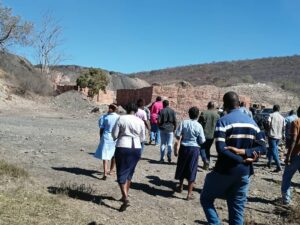
The provincial fire launch was held at Sydney primary school in Ward 24 of Matobo district. The delegates described the venue as befitting as it once had a fireguard project bordering Matopo National park and the nine villages of Shashane, Jeqe, Mafela, Mqabuko, Sydney Malunga, Mafuyana, Matojeni, Lookout Masuku, and Sizindeni.
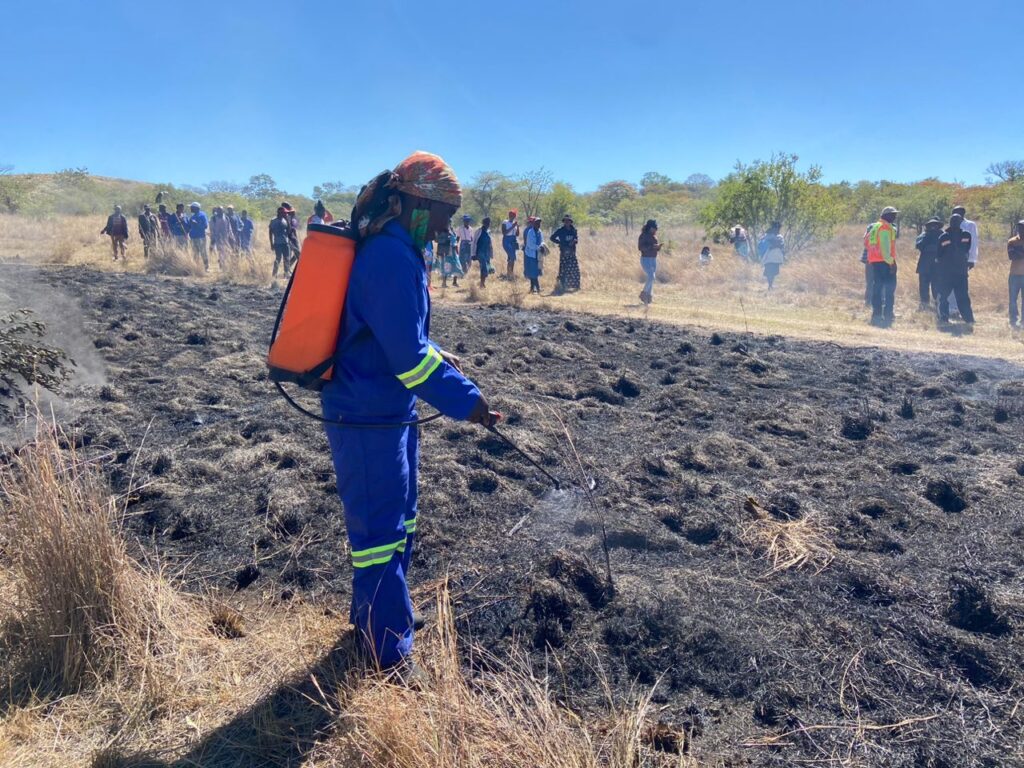
Malunga community members are reviving their fireguard project to protect themselves from oncoming veldfires as a pre-suppression measure. With a previous feud between Malunga community and the Matopo National Park, they agreed to put their differences aside and construct a fire guard that would protect both parties.
In accordance with the Parks and Wildlife Act (Statutory Instrument 72 of 2020), the Park officers had for years advised the community to maintain a prescribed distance from the border between the Park and community land in order to provide security for protected animals like the black and white Rhino kept there.
The instruction has been a hindrance to effective suppression drills during an outbreak of a fire in the Park. Community members were supposed to wait until the fire reaches their side of the border.
“We are happy that the Zimparks has agreed to work with us. This was the only way we could put out the fire without violating the Parks regulations,” added Siwa.
The news by Zimparks were received with jubilation as the community can now be able to fight fires before they reach their homesteads.
Matobo district has experienced an increase in veld fire incidences in recent years. This has been largely due to an increase in gold panning activities, poaching, arson and a host of other human activities.
According to the Statutory Instrument 7 of 2007 (Environmental Impact Assessment and Ecosystems Protection Regulations), a fire season is the period from the 31st of July to the 31st of October each year.
This is the period when communities are vulnerable to veld fires hence the law stipulates that no one should use fire outside the residential or commercial premises as means towards preventing outbreak of uncontrolled fires.
In an effort to enhance the country’s veld fire management capacity, every year the Ministry of Environment, Climate and Wildlife through the Environmental Management Agency, conducts a veld fire risk prediction using the Normalized Difference Vegetation Index (NDVI). This model provides important tools to predict, and design measures to minimise, both direct and indirect losses due to veld fires.
The 2024 prediction revealed that the country is in the medium (18.6%) to high risk (55.71%) to veld fires. The low risk zones cover 12.42% while an area which is in extreme high risk to veld fires covers 13.27% of the country.
Addressing the participants Matabeleland South EMA Provincial Environment Manager, Decent Ndlovu said, in 2023, a cumulative total of 858 361.9 hectares were destroyed by veld fires from 3 717 veld fire incidences, while the average burnt area per fire incident was 230.9 hectares down from 233 hectares in 2022.
“Such losses have a negative impact on the economy, and results in biodiversity loss, desertification, land degradation, drought, pollution, food insecurity and greenhouse gas emissions. There has been about a 50% reduction of area as compared to 1730 265 hectares destroyed in 2022,” said Ndlovu.

EMA said the decrease in average area burnt in 2023 was largely attributed to technical assistance rendered to communities, environmental education, training and capacity-development, and awareness campaigns done countrywide in collaboration with various stakeholders.
“Unfortunately, during the same fire restriction period, 1 (one) life was lost. In as much as this was a huge decrease (94%) as compared to 18 lives lost in 2022. However, every life lost is too many. It is sad to note that during the past decade (2013-23), more than 100 people have succumbed to veld fires, hence the need to put extra effort in fighting this scourge so that no life is lost in veld fire infernos,” said Maxwell Muvondori, the Minister of State for Matabeleland South Province representative.
Over recent years Zimbabwe has recorded veld fires outside the defined statutory fire season as a result of seasonal shifts due to climate change. Hence in the last two years the Minister of Environment, Climate and Wildlife gazetted different fire restriction periods to cater for the changing seasons, vis-à-vis veld fire management.
The country is currently experiencing the El Nino induced weather effects with a likely elongated dry season thus again increasing vulnerability to veld fires.
“Therefore, in light of the effects of the El Nino phenomenon the country is experiencing, these fire risk classes have to be carefully and closely monitored as they may culminate into extreme fire risk zones,” said Muvondori.
Veld fires have become an issue of National concern because their destructive nature. The Provinces highly exposed to the veld fires are Mashonaland Central, Mashonaland East, Mashonaland West and Manicaland. The districts that fall in extreme risk are Nyanga, Mutasa, Makoni, Mutare, Bindura, Makoni, Marondera, Chikomba, Hwedza, Harare, Zvimba, Mazowe, Centenary, Makonde, Hurungwe, Murehwa and Chimanimani.