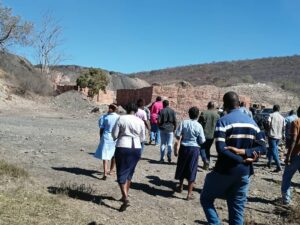
Zimbabwe has intensified its national response to veld fires through a series of linked but separately held environmental and fire management events aimed at improving prevention, and climate resilience ahead of the country’s peak fire season.
Over the past weeks, the government, through the Environmental Management Agency (EMA), convened three major programmes in Goromonzi District in Mashonaland East Province. The events included, the launch of the 2026 National Fire Week, the unveiling of the Integrated Fire Management Framework, and a regional technical workshop under the Integrated Fire Management Capacity Building and Knowledge Exchange Project. The project is being implemented in partnership with the United Nations Food and Agriculture Organization (FAO).
While the events were held independently, they collectively underscored growing concern over the rising frequency and intensity of veld fires in Zimbabwe amid worsening climate conditions.
Vice President Kembo Mohadi officially launched the 2026 National Fire Week at Goromonzi High School, calling for collective national action to combat veld fires that continue to destroy forests, crops, grazing land and infrastructure across the country.
Held under the theme “Prevent, Protect, Preserve: Combating Veld Fires Together,” the launch brought together Cabinet ministers, environmental officials, development partners, local leaders and community representatives.
Mohadi said veld fires were becoming a serious environmental and economic threat requiring stronger cooperation between government institutions, local communities and international partners.
“This is more than a launch, it is a national call to action,” he said.
“The devastating impact of veld fires continues to threaten our environment, biodiversity, food security and livelihoods. We must move beyond reaction and embrace prevention as a shared national responsibility,” Mohadi added.
He said government alone could not effectively fight veld fires without the involvement of communities, farmers, traditional leaders and private sector actors.
The vice president urged citizens to take responsibility for fire prevention avoiding activities that trigger uncontrolled fires during the dry season.
“Every Zimbabwean has a role to play in protecting our natural resources. From building fireguards to reporting outbreaks early, prevention begins with individual and community responsibility,” he said.
The vice president also warned that climate change was worsening fire risks across the country, making integrated environmental management increasingly urgent.
“As climate conditions become harsher, with prolonged dry spells and rising temperatures, the risk of uncontrolled fires continues to grow. This demands stronger coordination, preparedness and investment in sustainable land management practices,” Mohadi said.
The launch came as EMA warned that fire risks are significantly increasing across Zimbabwe due to hotter temperatures, low rainfall and dry vegetation conditions recorded earlier in the year.
According to EMA statistics presented during the National Fire Week launch, 41.93% of the country is currently under high fire risk, while 31.95% falls under medium risk and 11.69% under extreme risk. Authorities identified provinces in the Highveld region among the most vulnerable, with Goromonzi District emerging as one of the country’s major fire hotspots.
EMA and FAO also introduced Zimbabwe’s Integrated Fire Management Framework, a strategy designed to shift the country’s response from reactive firefighting to long-term prevention and preparedness.
Officials said the framework seeks to strengthen coordination among institutions while promoting sustainable land and fire management practices.
The programme focuses on community awareness, early warning systems, technical capacity building. It also looks at improved response coordination among environmental agencies and local authorities.
EMA officials said many veld fires in Zimbabwe are caused by human activities such as uncontrolled land clearing, hunting, burning of vegetation and careless disposal of cigarette stubs. The agency said stronger community participation would be central to reducing outbreaks.
“Fire management cannot be left to authorities alone. Communities are the first line of defence,” EMA officials said during the framework discussions.
The Integrated Fire Management Framework launch also highlighted the growing role of climate adaptation in environmental policy planning across southern Africa, where countries are increasingly facing prolonged droughts, and erratic rainfall patterns.
Following the launch in Goromonzi, a two-day regional technical workshop brought together environmental experts, technical specialists and regional partners to discuss operational planning and fire management strategies for the next three years.
The project is funded through Canada’s International Climate Finance Program and aims to strengthen fire preparedness systems and community resilience in fire-prone regions. The initiative marks a strategic shift away from emergency responses toward proactive fire prevention models rooted in local participation and climate resilience.
Discussions during the workshop focused on knowledge sharing, sustainable land management, early warning systems and coordinated regional responses to veld fires. Officials said the programme would also support technical training and institutional capacity development within Zimbabwe’s environmental sector.
Zimbabwe experiences thousands of veld fire incidents annually, particularly between July and October when dry winter conditions and strong winds increase the speed and spread of fires.