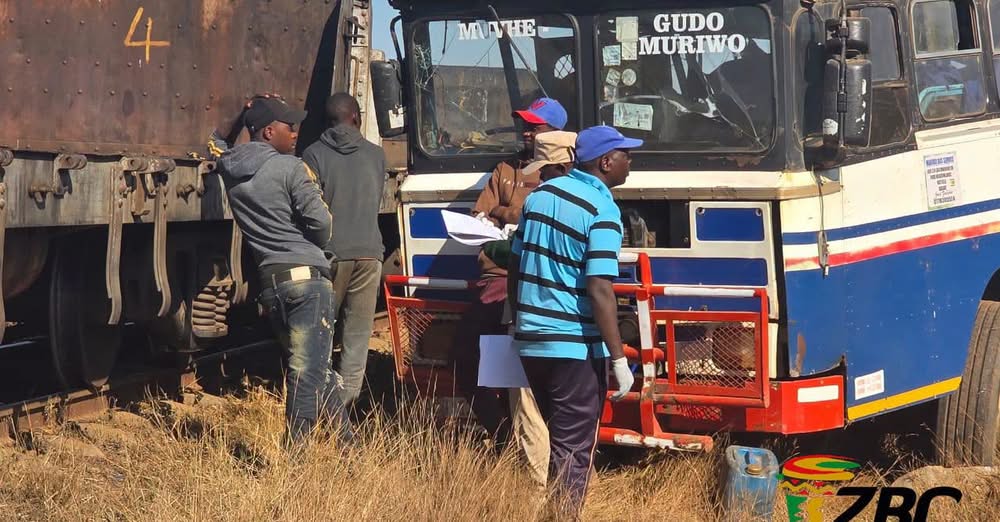
A bus and train wreckage after collision. Photo credit - ZBC News
Nine people have been killed and 25 others injured after a passenger bus collided with a National Railways of Zimbabwe train at a level crossing in Chiredzi, in a crash that has again placed Zimbabwe’s rail safety record under scrutiny.
In an official statement, the National Railways of Zimbabwe confirmed that the accident occurred at around 0700hrs when a train travelling from Triangle to the NRZ Lundi siding struck a bus at a level crossing. The rail operator said the bus driver failed to observe standard crossing procedures, which require motorists to stop, check for approaching trains, and proceed only when it is safe.
NRZ said seven adults and two minors died on the spot. Twenty-five passengers sustained injuries and were transported to hospital, where they are receiving treatment. Emergency services, including police, ambulances and the fire brigade, were deployed at the scene as rescue and recovery operations continue. The authority expressed condolences to the families of the deceased and wished the injured a speedy recovery, adding that, “further updates would be issued as verified information becomes available.”
The collision in Chiredzi, a low-lying agricultural and sugar-producing district in southeastern Zimbabwe, occurred at a level crossing on a route frequently used by both freight and passenger traffic linked to the Triangle sugar estates and surrounding commercial operations. While investigations are ongoing, early indications from NRZ point to human error at the crossing, a factor that has featured prominently in similar incidents across the country.
Zimbabwe Republic Police (ZRP) has confirmed the accident and promised to share more information as investigations are still underway.
The tragedy is the latest in a series of fatal rail-road collisions in Zimbabwe, where level crossing safety has remained a persistent challenge for years. In multiple previous incidents, trains and road vehicles have collided at unmanned or lightly protected crossings, often with devastating consequences. Authorities have repeatedly attributed such crashes to motorists ignoring warning protocols, misjudging train speed, or attempting to cross during unsafe conditions.
In one earlier incident along the Harare rail corridor, a bus collided with a train at a crossing, leaving at least one person dead and several others injured after the vehicle entered the tracks without stopping. Similar crashes have been recorded in both urban and peri-urban areas, highlighting the risks posed by high road traffic volumes intersecting with ageing rail infrastructure.
Beyond level crossing incidents, Zimbabwe’s rail network has also faced recurring operational safety challenges. In January 2026, a freight derailment near Odzi, along the Harare–Mutare line, disrupted services after wagons left the tracks following heavy rainfall that caused track washaways. The incident underscored the vulnerability of sections of the network to extreme weather and drainage failures, particularly in rural stretches where maintenance is often delayed.
In 2025, another derailment involving a coal-laden train near Kadoma was reported after heavy rains weakened the track foundation, though no fatalities were recorded in that incident. Across several such events, NRZ has cited a combination of ageing infrastructure, weather impacts, and funding constraints as key factors affecting rail safety and reliability.
Many crossings across the country still rely on basic signage rather than automated barriers or active warning systems, leaving safety heavily dependent on driver behaviour and visibility conditions at the time of crossing.
The pattern of repeated rail-related accidents has intensified calls for investment in rail infrastructure and road-rail interface safety. For communities like Chiredzi, where rail lines remain a key part of freight and passenger movement tied to agricultural production, the dangers at level crossings are a familiar but unresolved reality.