VICTORIA FALLS – Africa’s leaders and energy officials have called for a major expansion of solar power, but warned that the continent will need far more than sunshine to deliver a fair and lasting energy transition.
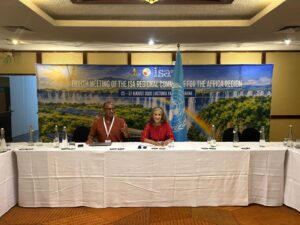
The warning came at the eighth meeting of the International Solar Alliance’s Regional Committee for Africa in Victoria Falls, where governments and development partners are seeking ways to turn Africa’s vast solar potential into electricity, jobs and economic opportunities.
Zimbabwean President Emmerson Mnangagwa said Africa must use renewable energy to support industrialisation, strengthen local economies and expand access to essential services.
“Africa possesses some of the world’s richest natural endowments,” Mnangagwa said. He called for solar resources to be used to “industrialise, modernise, and scale up access to essential services.”
He also urged greater participation by women and young people in the renewable-energy economy. Africa, he said, must build the capacity to manufacture, install, adapt and maintain solar technology locally.
That issue was echoed by African Union Commissioner for Infrastructure and Energy Lerato Dorothy Mataboge.
Energy is not simply another development sector, she said. It is the infrastructure on which wider economic transformation depends. Africa cannot industrialise, process its minerals, develop modern agriculture or build competitive manufacturing without reliable electricity, Mataboge said.
She warned, however, that the continent’s biggest obstacle remains finance.
“Our greatest constraint remains finance, and particularly the cost of capital,” she said.
Projects that are technically sound can become financially unviable because borrowing costs are too high. Public and concessional finance must therefore be used more strategically to reduce risk and attract private investment. The ISA is also pressing for greater local participation in the solar value chain.
Its new Solarising Africa strategy identifies local manufacturing and skills development among the measures needed to scale solar. The alliance says solar capacity could rise from about 20-22 gigawatts today to 150-200 gigawatts by 2030, 500 gigawatts by 2040 and 1 terawatt by 2050.
But the ambition comes with a warning about who benefits from the transition.
The African Union says solar expansion should create opportunities for African workers and businesses, not simply increase dependence on imported equipment. That concern is particularly important as countries seek to build new supply chains around batteries, transmission equipment, solar panels and other technologies.
The meeting is also focusing on agriculture, one of the areas where solar power could have an immediate social impact.
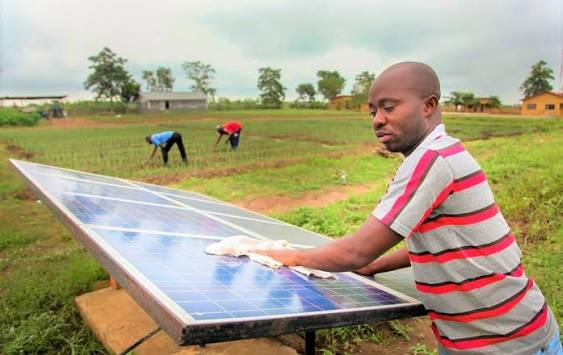
The ISA launched a Community of Practice on the Solarisation of Agriculture in Africa, allowing countries to share experience on solar irrigation and agrivoltaics, where solar generation is combined with agricultural production.
Uganda, Zimbabwe, The Gambia, Ghana, Senegal and Rwanda backed the Zimbabwe Declaration on solar water pumps and agrivoltaic solutions, according to the alliance.
The ISA also launched a solar-water-pumping e-learning programme aimed at making practical knowledge more accessible to farmers. In rural communities, distributed energy could offer another route to electricity where national grid expansion remains difficult.
The alliance says its Africa50 Distributed Renewable Energy Fund will seek to mobilise concessional, institutional and private capital for projects serving rural communities, farmers, small and medium-sized enterprises and other productive users.
The International Solar Alliance’s director general, Ashish Khanna, said Africa was ready to move from megawatts to gigawatts of solar, citing growing political commitment, stronger alignment between governments and development partners, and falling costs for solar and storage.