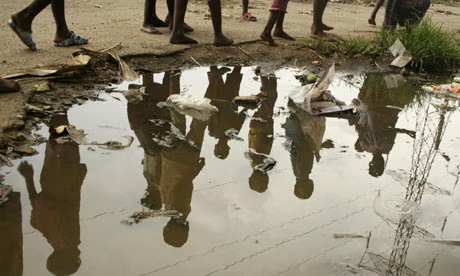
Photo Credit - AP
While following a weekly guest show at the Besana community roundtable early this year, something moved the audience – the guest Loy Campbell was breaking the silence. At 22, Campbell has already witnessed more suffering than most people her age. Born in the Cayman Islands and now pursuing a postgraduate degree in the UK, she spends her spare time volunteering with Women’s Aid, supporting women and children who have fled abusive homes.
Her advocacy, however, is not confined to her volunteer role. Campbell speaks openly about an issue that many societies prefer to ignore: childhood sexual trauma. “It’s not just about what happened,” she says. “It’s about how it changes the way a person goes about life. Trauma reshapes trust, identity, relationships, and even how a child sees themselves.”
In Zimbabwe, where many young girls suffer sexual abuse, her words resonate deeply. Reports from advocacy organisations operating in the Southern African country show that child sexual abuse is a silent epidemic.
At a busy commuter rank in Harare, a Grade 7 pupil was recently sexually abused by a tout who preyed on her vulnerability. According to witnesses and child-rights advocates, the girl had been waiting for transport when she was lured away and allegedly raped. The case sparked outrage, with child rights campaigners warning that the chaos and lack of regulation at ranks create dangerous spaces for children, particularly young girls.
Police have since confirmed investigations into the incident, while rights groups have called for stricter enforcement of child-protection laws and better monitoring of public transport ranks.
The Zimbabwe National Statistics Agency (ZIMSTATS) estimates that 32.5% of females and 8.9% of males aged 18–24 reported experiencing sexual violence before the age of 18. Yet the real number is likely much higher, as most cases never reach the courts. Families fear community gossip. Survivors are pressured to protect “family honour.”
“Abuse is so normalised in some societies that it’s not even recognised as abuse anymore,” Campbell explains. “If a child speaks up and no one cares, it confirms the false belief that the abuse is somehow their fault.”
This culture of silence is what survivors like Ruth Moyo’s* daughter had to endure. Moyo recalls the day her 12-year-old confided that a trusted neighbour had been abusing her. “At first, I wanted to deny it,” she says quietly. “But she looked me in the eyes and said, ‘Mum, he touched me.’ My relatives told me to hush it up, ‘What will the neighbours think?’ they asked. But I chose to believe her. That’s what saved us.”
The Lasting Scars
The effects of childhood sexual trauma are profound, both immediate and long-term. Children may suddenly develop phobias, withdraw from loved ones, or show unexplained aggression. Others regress, wetting the bed or having recurring nightmares. Some display sexual knowledge far beyond their age.
As survivors grow older, these symptoms often transform into chronic struggles. “Persistent trust issues, destructive behaviours like substance abuse, anxiety, depression, and even PTSD,” Campbell says. “Many carry guilt and shame. Some avoid intimacy altogether; others become hypersexual as a way of coping. Without intervention, childhood trauma can repeat itself in cycles.”
Psychologist Dr. Natasha Changara, who runs a counselling practice in Harare, sees this cycle unfold in her daily work.
“Adults come in for marital issues, but beneath the arguments lies unresolved childhood trauma. It shapes their ability to connect, to trust, to feel worthy of love. Healing is possible, but only if the trauma is acknowledged,” she explained.
One of the greatest challenges is that children rarely disclose abuse directly. Caregivers, teachers, and health professionals must instead notice subtle behavioural shifts.
“A once outgoing child becomes withdrawn. A quiet child suddenly turns aggressive. They develop sleep problems, panic attacks, or become hyper-aware of their body,” Changara explains. “Sometimes, they cover themselves in baggy clothes regardless of the weather, or the opposite, they start dressing provocatively, as if their body is not their own.”
Such changes, however, are often misinterpreted as misbehaviour. “Parents tell their children, ‘Why are you acting out?’ instead of asking, ‘What happened to you?’” says Changara. “That’s why education for adults is just as important as for children.”
Why, then, do so few children speak out?
“The biggest barrier across most cultures is shame,” Campbell argues. “Abusers manipulate children into believing the abuse is their fault. Families, desperate to protect reputations, silence survivors instead of supporting them. That silence is devastating.”
In Zimbabwe, silence is sometimes compounded by religious and cultural beliefs. Survivors may be forced to marry their abusers. Families may accept financial settlements instead of seeking justice. And girls are often blamed for “provoking” men with their behaviour.
“The abuser’s shame becomes the survivor’s burden,” says Campbell. “This must change. Education is key, teaching children from a young age about boundaries, consent, and their right to say no.”
Healing the Wounds
While prevention is vital, supporting survivors already affected by abuse is equally urgent. The first step, Changara insists, is to believe the child. “It’s very rare for a child to make up such trauma. Dismissing their disclosure is another wound, sometimes deeper than the abuse itself.”
Once trust is established, therapeutic approaches vary. Trauma-focused cognitive behavioural therapy helps survivors process memories in a safe environment. Somatic therapy addresses trauma stored in the body. Play and art therapy allow young children to express what they cannot verbalise. For those who are religious, faith-based counselling can provide comfort.
But therapy alone is not enough. “A strong support system is crucial,” Changara says. “If a child goes home to silence or blame, healing cannot happen. They need safety, stability, and love.”
In Mutare, Pastor Goodwill Chihota has seen this firsthand through his small church-based programme for survivors. “We combine prayer with art therapy,” he explains. “But the real healing happens when families learn patience. Recovery is never linear. There are setbacks, but with love, a child can reclaim their life.”
Without support, childhood trauma often shapes survivors’ adult lives in destructive ways.
“It can create a warped understanding of intimacy,” Campbell says. “Some build walls so high they never let anyone in. Others let everybody in because they’re desperate for love, falling into toxic patterns. Survivors may mistake toxicity for passion, settle for abusive relationships, or, in rare cases, become abusers themselves as a misguided way of reclaiming control.”
Healing, she insists, is possible. But without intervention, trauma reverberates through generations.
The solution, experts agree, begins with prevention. “Children must be taught about consent and boundaries,” says Campbell. “They need multiple trusted adults they can turn to. And institutions such as schools, churches, police, must act when abuse is reported. Too often, cases are ignored or buried.”
Despite the trauma, many survivors go on to rebuild their lives. The key, Changara notes, is resilience, fostered by strong support networks, letting go of guilt, faith for those who believe, and reclaiming control through therapy, advocacy, or personal growth.
“Taking back your power leads to healing,” she says.
For Moyo and her daughter, resilience meant refusing to be silenced. They sought counselling, confronted their community, and now speak openly to other parents about recognising the signs. “We are not broken,” Moyo says. “We are healing. My daughter is laughing again. That’s our victory.”