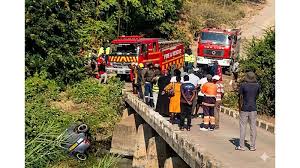
Just after sunrise on 23 May, the Toyota Noah carrying Roman Catholic pilgrims approached Deka Bridge outside Hwange. The congregants had spent the night at St John’s Makwa Mission, attending an all-night prayer service. They were travelling home to Victoria Falls, exhausted but hopeful after a night of worship.
Minutes later, eight of them would be dead.
The vehicle veered off Deka Bridge and plunged into the Deka River below, triggering one of Zimbabwe’s deadliest road accidents this year and leaving a church community mourning the loss of worshippers who had set out seeking spiritual renewal and never returned home.
Police confirmed that eight Roman Catholic congregants died in the crash while six others survived with injuries and were rushed to Hwange Colliery Hospital. Rescue teams drawn from Hwange Colliery Company, the Zimbabwe Power Company, the Hwange Local Board and Civil Protection structures were deployed to recover victims and assist survivors.
For the families waiting in Victoria Falls, the hours that followed were filled with uncertainty as authorities worked to identify victims and account for survivors.
Zimbabwe Republic Police spokesperson Commissioner Paul Nyathi later released the names of those who died, including a four-year-old girl, Keila Nduba, whose death became one of the most painful symbols of the tragedy. The other victims ranged in age from 37 to 72 years old.
“The Zimbabwe Republic Police extends its deepest condolences to the families of the victims,” Nyathi said, urging motorists to prioritise road safety on the country’s roads.
But as funerals began and church bells rang across the Diocese of Hwange, grief quickly evolved into questions.
How had a routine journey ended in disaster?
And why do Zimbabweans continue to die on roads that communities have long described as dangerous?
Within days, President Emmerson Mnangagwa declared the Deka Bridge accident a State of Disaster, an unusual step intended to mobilise government resources for affected families and survivors. The declaration enabled authorities to coordinate funeral assistance and medical support while investigations continued.
Daniel Garwe, the minister of local government and public works, said emergency services led by the Zimbabwe Republic Police had responded swiftly and that investigations into the circumstances surrounding the crash were underway.
Yet for residents of Hwange, the focus quickly shifted beyond the immediate cause of the accident.
Fidelis Chima, coordinator of the Greater Hwange Residents Trust, said the tragedy highlighted long-standing concerns about road infrastructure in the district.
“It is sad that eight people died,” Chima said. “The Deka Bridge is extremely narrow and the road is in a poor state.” He argued that local authorities should have greater capacity to maintain roads within their jurisdictions, adding that much of the region’s road network was in poor condition.
Those concerns are not new.
The Deka corridor is a critical transport route linking communities across Hwange district. Residents, motorists and civic groups have repeatedly raised concerns about road conditions and safety along sections of the route. The latest accident renewed debate about whether enough has been done to improve infrastructure and reduce risks to road users.
Police investigations have meanwhile focused on the circumstances immediately surrounding the crash.
The driver, Fanuel Mathe, survived and was subsequently charged with culpable homicide while investigations continue. Authorities stressed that such charges are standard procedure following fatal accidents and do not predetermine the outcome of the investigation.
Inspector Glory Banda, spokesperson for the Matabeleland North police, said investigators were working alongside the Vehicle Inspection Department.
“I confirm that he has been charged with culpable homicide,” Banda said. “Investigations are instituted to determine what happened.”
The inquiry is expected to examine factors including vehicle condition, driver conduct and road circumstances at the time of the crash. Some early eyewitness accounts suggested possible mechanical failure, although authorities have not publicly determined the cause.
For the Roman Catholic community, however, the technical details offer little comfort.
In the days after the accident, the Diocese of Hwange announced three days of mourning. Churches across the diocese held special masses in memory of those who died.
Bishop Raphael Ncube described the victims as brothers and sisters whose loss would be felt throughout the church community. All masses during the mourning period were dedicated to the deceased congregants.
Road accidents have become a recurring feature of Zimbabwean life. Fatal crashes involving commuter vehicles, buses and haulage trucks routinely dominate headlines. Public outrage often follows major accidents, accompanied by calls for stronger enforcement, better infrastructure and improved vehicle inspections.
Yet meaningful reforms have often struggled to keep pace with the scale of the problem.
Road safety advocates argue that enforcement alone cannot solve the crisis. They point to a combination of ageing infrastructure, inadequate maintenance, vehicle defects, overcrowding and economic pressures that encourage risky transport practices.