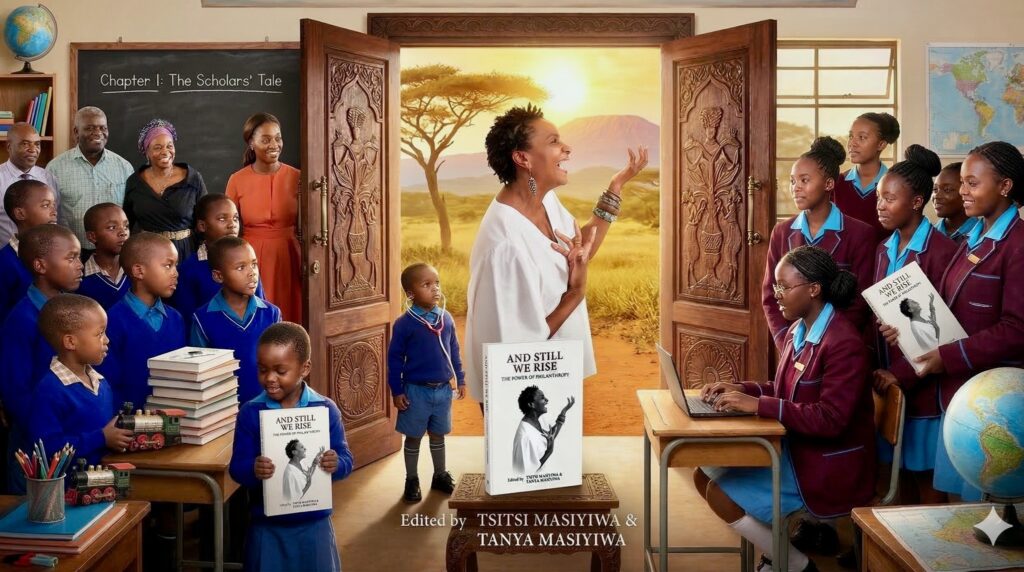
In an era defined by seismic geopolitical shifts, mounting inequality, and global realignments in economic power, a compelling new voice has emerged from the heart of Africa. The voice is not calling for charity, but for strategic, long‑term investment in human potential. ‘And Still We Rise: The Power of Philanthropy’, a new anthology edited by Zimbabwean philanthropist Tsitsi Masiyiwa, and her daughter Tanya Masiyiwa offers more than memoir; it proposes a transformative philosophy of giving that could help reshape how the world understands development and empowerment on the continent.
At its core, the book is a chronicle of a three‑decade journey. It documents the evolution of the Higherlife Foundation, the philanthropic organisation Ms. Masiyiwa co‑founded with her husband, Strive Masiyiwa, in 1996. The organisation was founded from a modest response to Zimbabwe’s HIV/AIDS crisis into one of Africa’s most significant home-grown philanthropic movements.
For many outside Africa, philanthropy remains synonymous with short‑term relief or the imposition of Northern priorities under the banner of aid. Yet, ‘And Still We Rise’ insists on a different narrative. A strategy rooted in local agency, long‑term commitment, and partnership with communities rather than distant benefactors. The book’s strength lies not only in its stories but in its challenge to entrenched assumptions about who should lead and define philanthropy in Africa.
The narrative begins in the mid‑1990s, when Zimbabwe was grappling with the devastating impact of the HIV/AIDS epidemic. In the shadow of countless lives lost and families fractured, Tsitsi Masiyiwa and her husband made a personal pledge; to support orphaned and vulnerable children left behind by the pandemic. What began as a targeted scholarship initiative soon expanded into something far larger.
Today, the Higherlife Foundation’s work spans education, health, rural development, sustainable livelihoods, and community empowerment. It reflects a holistic vision, one that sees human potential not as an abstract ideal but as a concrete investment with measurable impact. Nearly half a million scholarships have been awarded across multiple African countries. The foundation works closely with governments and local partners to reinforce systems that enable lasting progress.
What emerges is a clear message; philanthropy that merely patches gaps left by underfunded public systems is insufficient. If the goal is genuine transformation, philanthropy must work at the systemic level, complementing and enhancing the capacities of governments, civil society, and private sectors. Mrs. Masiyiwa and her daughtershare candid reflections from educators, health professionals, and beneficiaries, not as testimonials of gratitude alone, but as evidence of what sustained investment over years can achieve.
In a global context marked by growing scepticism of foreign aid and rising calls for “local ownership,” ‘And Still We Rise’ arrives at a timely moment. The book implicitly critiques a development paradigm that too often equates financial inflows with impact, irrespective of who defines the terms of success. Instead, it champions a model of giving that is rooted in local realities, informed by lived experience, and accountable to the communities it intends to serve.
This is not merely an academic debate. Across Africa, civil society organisations and local foundations face chronic underfunding and systemic marginalisation from global philanthropic flows. According to sector research, while the continent attracts significant giving overall, only a small portion directly reaches indigenous organisations, particularly those led by women and grassroots actors. These dynamics limit the capacity of local institutions to scale impact or innovate solutions tailored to their communities. The very idea of an African philanthropy for Africa, as espoused in Higherlife Foundation work, confronts this imbalance head on.
Indeed, Mrs. Masiyiwa herself has long advocated for strategic, long‑term engagement that goes beyond episodic interventions. Her leadership within organisations such as the African Philanthropy Forum and her role as chair of global philanthropic initiatives reflect a broader commitment to reshaping the philanthropic ecosystem, locally and internationally. ‘And Still We Rise’ synthesises these insights not as a manifesto, but as lived practice.
What gives the book its emotional force are the personal narratives woven throughout. A scholarship recipient from Lesotho reflects on how education opened doors to unexpected opportunities. A health practitioner from Burundi recounts the impact of sustained support on community health outcomes. These stories highlight a vital truth – philanthropy is ultimately about people, not numbers. When interventions are built around dignity, and mutual respect, their effects ripple outward, transforming families, institutions, and entire communities.
But the book also acknowledges challenges and failures. It presents unvarnished accounts of setbacks, missteps, and lessons learned, a rare approach in a sector that often prefers curated success stories. This honesty is not self‑deprecating, but instructive; it underscores that the path to sustainable impact is rarely linear and that humility must be part of any serious philanthropic effort.
From an international perspective, the significance of ‘And Still We Rise’ extends well beyond its pages. As global development paradigms shift, influenced by debates over decolonisation, power asymmetries, and the failures of traditional aid models, there is a growing appetite for alternatives shaped by those closest to the problems they aim to solve. This book offers one such alternative, grounded in practice and validated by decades of collective work.
In an African context, the model championed by Higherlife Foundation resonates deeply. Across the continent, millions of young people are navigating a world of rapid change, from technological disruption to climate instability. Solutions that fail to harness local expertise and leadership will falter. But when investment is long‑term, and collaborative the outcomes can be transformative.
For international philanthropists, policymakers, and development practitioners, the book is a reminder; impact is not measured solely by dollars spent, but by the sustainability and agency of the beneficiaries whose lives are touched.
‘And Still We Rise’ is not just a retrospective. It is a call to action, to rethink how the world gives, whom it listens to, and what it values most in the pursuit of progress. Tsitsi Masiyiwa’s journey is uniquely African, yet its lessons are universal. Resilience, partnership, and a steadfast commitment to human potential can yield change that outlasts generations.
In charting the evolution of the Higherlife Foundation and elevating voices from across the continent, the book redefines success in philanthropy, not as a momentary gesture of giving, but as a lifelong investment in people and communities. For Africa and the world, that message has never been more needed.