VICTORIA FALLS – A new financing partnership linking the World Bank, International Solar Alliance, Africa50 and Nigeria’s sovereign wealth fund is seeking to unlock private investment in distributed renewable energy as Africa races to bring electricity to 300 million people by 2030.
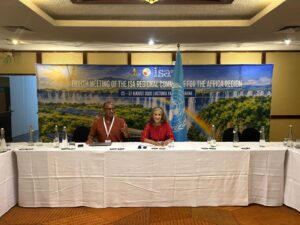
Thomas Flochel of the World Bank said the agreement announced at the International Solar Alliance’s eighth Regional Committee Meeting for Africa in Victoria Falls was designed to combine public and concessional finance with private capital to expand electricity access across the continent.
“Achieving universal energy access in Africa requires the combined strengths of public institutions, private investors, and market leaders working together toward a common goal,” Flochel said in remarks at the meeting.
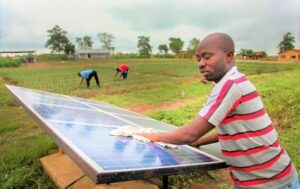
The partnership is being developed around the Africa Solar Facility, a US$200 million facility launched by the International Solar Alliance to finance distributed solar projects in Africa. Africa50 signed a term sheet with the ISA in December 2024 to manage and implement the facility, which is intended to provide financing for distributed renewable-energy projects that have struggled to attract sufficient capital because of their relatively small size and perceived risk.
Flochel said the initiative would complement Mission 300, the World Bank Group and African Development Bank Group effort to connect 300 million people to electricity across sub-Saharan Africa by 2030.
That target was established against a major electricity-access deficit. The World Bank and AfDB said in June 2026 that Mission 300 had already connected more than 50 million people in 40 countries, leaving 250 million people to be reached before the end of the decade.
The programme is not limited to solar. Mission 300 covers the energy system from generation and transmission to last-mile distribution, combining on-grid and off-grid approaches. The World Bank says the initiative counts verified electricity-access results rather than simply the number of projects financed.
That distinction matters because much of Africa’s electricity deficit is in communities where extending conventional grids can be costly or technically difficult.
Flochel said the new financing structure was intended to help address precisely that market gap.
Under the arrangement he outlined, Africa50 will use its infrastructure investment experience to identify and finance distributed renewable-energy opportunities. The International Solar Alliance will provide concessional resources and convening power, while the World Bank’s International Development Association will provide patient, concessional capital designed to improve the risk-adjusted returns of investments and attract additional private finance.
World Bank project documents confirm that the Mission 300 Patient Capital Facility is being implemented through Africa50 and is intended to provide long-term equity financing to distributed renewable-energy companies. The facility is designed to take higher-risk positions to attract additional private capital into the sector.
Africa50’s own documents say the broader Distributed Renewable Energy platform combines the US$200 million Africa Solar Facility with a separate Nigeria-focused distributed-renewable-energy fund targeting US$500 million. The platform was developed with the ISA, the Nigerian Sovereign Investment Authority and Sustainable Energy for All.
For Flochel, however, the measure of success will be what the money delivers on the ground.
“It will be measured by the entrepreneur who can keep a business open after dark, by the health clinic that can provide better care, and by millions of people whose lives and opportunities will expand because energy has become accessible, reliable, and affordable,” he said.
Nigeria offers an early illustration of how private-sector-led distributed energy can be combined with public finance.
The World Bank said in June that more than 4.5 million Nigerians had gained electricity access through private-sector-led initiatives under Mission 300, demonstrating the role of public support and partner financing in developing commercially viable energy markets.
Nigeria has also accumulated experience in using mini-grids and other distributed systems outside the national grid. Earlier World Bank-backed programmes helped establish solar hybrid mini-grids and expand solar home systems, while the newer Distributed Access through Renewable Energy Scale-Up programme is intended to reach millions more people. The World Bank has described mini-grids as an important route to electrification for communities that are difficult to connect to conventional networks.
Tanzania provides another measure of the pace that investment and policy reforms can make possible. The World Bank reported in June that 7.5 million Tanzanians had gained access to electricity under Mission 300, five times the country’s previous average annual pace of electrification.
The World Bank says governments participating in Mission 300 are also developing National Energy Compacts, setting out country-level reforms and targets to expand affordable electricity, scale renewable energy, strengthen utilities, integrate regional power systems and increase private-sector participation.
But the financing challenge remains substantial.
Africa50’s investment model is intended to address some of those constraints by using equity and other forms of risk capital to develop projects and attract additional commercial investors. The organisation says its role is to develop bankable infrastructure projects, catalyse public capital and mobilise private-sector funding.
Africa has abundant solar resources, but generation capacity cannot translate into access without distribution systems, storage, viable utilities and customers able to pay for electricity. Mission 300’s approach therefore places distributed renewables within a broader effort to reform the power sector and improve the conditions for investment.
Flochel described the partnership signed in Victoria Falls as the beginning of a longer-term effort rather than an end in itself.
“Let us now move from ambition to delivery,” he said.