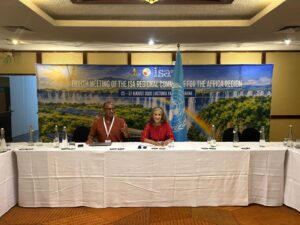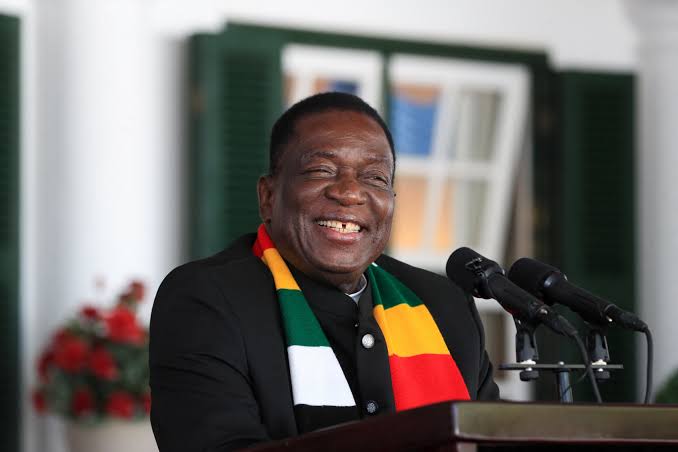
VICTORIA FALLS – Zimbabwean President Emmerson Mnangagwa on Wednesday urged African countries to move beyond discussions about solar power and focus on projects, financing and local industries. He spoke as the International Solar Alliance opened its eighth Regional Committee Meeting for Africa in Victoria Falls. Mnangagwa said Africa must use its solar resources to create jobs, strengthen industries and expand access to electricity.
Addressing delegates in Victoria Falls, Mnangagwa said Africa’s transition to renewable energy could not be measured simply by the number of solar panels installed or megawatts generated. Instead, he said, the continent should use its renewable resources to create jobs, strengthen industries, improve food security and expand access to electricity.
The meeting brings together representatives of African governments, development partners, financial institutions and the private sector to discuss ways of accelerating solar deployment across a continent with some of the world’s richest renewable energy resources but where millions of people still lack reliable electricity.
Mnangagwa said the country’s hosting of the meeting reflected growing international cooperation around Africa’s role in the global energy transition.
“The International Solar Alliance provides us an opportunity to strengthen Africa’s economic integration, share experiences, build capacity, develop projects, promote technologies and mobilize investments,” he said.
He said the recommendations emerging from the meeting should offer practical solutions to help African countries translate solar potential into economic development and improve living standards.
Africa’s energy systems are undergoing rapid change, driven by climate commitments, technological advances and falling costs for renewable energy technologies, Mnangagwa said. But he added that the continent’s vast natural resources should be viewed as instruments for economic transformation rather than merely commodities to be exploited.
“Our African continent, which possesses some of the world’s richest resources, must industrialize, modernize and scale up access to essential services,” he said.
Reliable energy access, he said, remained fundamental to achieving Africa’s development ambitions under the African Union’s Agenda 2063. Solar energy, because of its widespread availability, offered African countries an opportunity to increase energy access while supporting broader economic development.
But the president cautioned that achieving that potential would require deliberate action by governments and other stakeholders.
“I call upon us to deliberately set out sound policies, effective institutions, appropriate technical standards, transparent procurement systems and reliable infrastructure,” Mnangagwa said.
The financing of Africa’s energy transition was among the central challenges raised in his address. He said the scale of investment required for electricity generation, transmission, distribution, mini-grids, off-grid systems and energy storage could not be met by governments alone.
He called for stronger partnerships between governments, development finance institutions, investors and private companies.
“Financing solar energy transition must be designed around Africa’s realities,” he said, adding that investments should support priorities including food security, employment creation and climate resilience.
Independent power producers and private-sector companies operating in areas such as mining and manufacturing were being enabled to develop energy solutions while contributing to the national electricity mix, he said.
The president also challenged the International Solar Alliance to help member states develop standardized approaches, prepare viable projects and connect them with appropriate sources of financing.
“Africa’s energy transition must be just and inclusive. I challenge our entrepreneurs, the youth and women across the continent of Africa to boldly participate in solar energy value chains,” Mnangagwa said.
The success of the transition, he argued, should not only be measured in generating capacity or the amount of equipment installed.
“Our collective success should not only be measured in megawatts generated and installed, but in empowered lives, jobs created, enterprises developing, local capabilities and the broader trade in energy solutions,” he said.
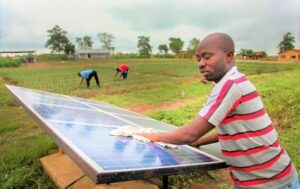
Mnangagwa highlighted agriculture as one of the sectors where solar power could have a significant impact, particularly in a continent increasingly affected by droughts, climate variability and pressure on food systems.
In Zimbabwe, renewable energy forms an important part of the country’s energy security and economic development strategy. The use of solar power in agriculture could support irrigation, food production, climate resilience and improved rural incomes.
Zimbabwe has also set out broader targets for expanding renewable energy access through its National Development Strategy, including utility-scale solar projects, mini-grids, solar-powered systems for public institutions and other productive uses.
Mnangagwa said the country’s Presidential Solar Programme, which is intended to support more than 1.2 million households, was expected to accelerate electricity access, particularly in rural communities.
Zimbabwe, he added, supported a stronger institutional presence for the alliance in Africa and welcomed the establishment of an ISA country office in the country.
His emphasis on implementation echoed a broader theme emerging from the meeting, where delegates have focused on closing the gap between Africa’s enormous renewable energy potential and the number of projects that successfully reach financial close and construction.
“As the current group of Africa’s leaders, we shall continue to assume our shared obligation and responsibility to improve the quality of life for our people. Africa’s resources remain the solid foundation for energy security and self-sufficiency, as well as industrialization, modernization and shared prosperity for all,” he said.