General Comment No.26
Every day as he grew older, 13-year-old Cain Moyo (actual name withheld) observed that the air in his hometown of Hwange was becoming more and more polluted. He has only ever known this life of dust, and sadly, it seems to be getting worse every day.
Despite being well-known for its enormous coal reserves, which give many residents jobs, Hwange has been a source of worry for its citizens because of the unpleasant environment, as some local environmental activists have noted.
“The coal mining, coke production, and electricity generation here are posing threats to residents’ lives,” warns environmentalist Amon Ngwenya. “It is concerning that children and people of all ages are being impacted by these airborne illnesses. It is imperative that businesses transition to more intelligent technologies for coal mining and coal product utilization.”
Unfortunately, Moyo is not the only youngster who is troubled by his hometown’s ongoing pollution, environmental damage, and unsustainable use of natural resources.
Another16-year-old youngman from the same neighborhood expresses concern about the future, stating, “Our community could face significant financial and social loss if the present pace of forest destruction and manhole creation continues.”
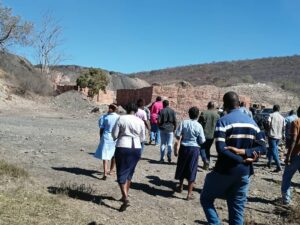
Significant land degradation has resulted from mining companies’ failure to rehabilitate the land after extraction, painting a harsh picture of the situation. Unfilled manholes are frequently the result of this neglect, endangering children and wildlife alike.
The terrible event of a 9-year-old child in Hwange who tragically died after being severely scorched by underground fires in 2021 serves as a wake-up call. Although the Hwange Colliery Company maintains that these poor victims are encroaching on their private property or no-entry zones, the locals called on mining companies to take proactive steps to protect people and the environment.
On 3 October this year, the Ministry of Public Service, Labour and Social Welfare and Ministry of Environment, Climate and Wildlife, together with UNICEF Zimbabwe, reiterated their support for the United Nations Convention on the Rights of the Child (UNCRC) General Comment No. 26.
Children have a fundamental right to a clean, safe, and sustainable environment, as the UNCRC has persuasively said. The UNCRC General Comment No. 26, which gives members a thorough grasp of their responsibilities under the UNCRC, consolidates this position.
In order to improve the lives of children, UNCRC General Comment No. 26 strongly encourages Member Nations to take bold action to save the environment.
Endorsed in 1989 and ratified by an impressive 196 Member Countries – including Zimbabwe – this Convention champions universal children’s rights, with a focus on life, survival, and development. A UNCRC General Comment provides guidance on how these rights affect certain topics or areas of legislation.
Recently published, the “General Comment No. 26 on Children’s Rights and the Environment, majorly focusing on Climate Change” specially concentrates on the current climate crisis, the deterioration of biodiversity, and extensive pollution. It describes possible tactics to shield the next generation from these broad environmental issues.
According to UNICEF Zimbabwe, protecting children from harm now is only one aspect of protecting them from future rights violations brought on by our states’ actions—or lack thereof—today.
“States are being urged to think long-term and take into account the disproportionate harm that underprivileged children experience. This is not about abandoning any child or location,” says Yves Willemot, UNICEF Zimbabwe’s Chief of Communications.
“The 196 States that have ratified the Convention on the Rights of the Child are committed to taking immediate actions, such as converting to renewable energy sources, improving air quality, ensuring access to clean water, transforming industrial agriculture and fisheries for the production of sustainable, healthful food, and conserving biodiversity,” he adds.
Interestingly, the UNCRC General Comment No.26 proposes that children’s views must be taken into account during environmental decisions. It emphasizes how important climate and environmental education is in empowering kids to take action and defend themselves against environmental dangers.
“Unfortunately, children are frequently disregarded during community engagement when talking about Environmental Impact Assessments (EIA) in Hwange. We are striving to alter this regrettable reality,” acknowledges Ngwenya.
The Paris Agreement’s requirements for States to protect, advance, and take into account children’s rights when addressing climate change are clarified by General Comment No. 26. It also makes it clear that all laws, programs, initiatives, rules, budgets, and other choices pertaining to the environment must include effect evaluations on children’s rights.
As a result, states are expected to update the UN Committee on their progress in defending the environmental rights of children on a regular basis.
According to the Ministry of Environment, Climate, and Wildlife, Zimbabwe’s legislative and policy tools clearly reflect our focus on and commitment to children’s rights, particularly in key climate change frameworks such as the draft National Adaptation Plan, the revised Nationally Determined Contributions and its Implementation Plan, and the National Climate Policy.
In a joint statement with other interested parties, the Ministry stated, “The Government of Zimbabwe ensures that the voices of children and youth are heard in the climate change discussion and the country’s stance towards the annual Conference of Parties to the United Nations Framework Convention on Climate Change (UNFCCC).”
“Moreover, the government is actively assisting schools across the nation to establish disaster risk management protocols. This is achieved by enhancing climate change education, fortifying climate-resilient infrastructures, basic amenities like renewable energy sources, and water supplies. In addition, they aim to cultivate a practical learning environment that nurtures environmental guardianship among Zimbabwe’s young population via the Clean Green Initiative,” the ministry elaborates.
Environmental activists claim that despite the improvement that has been seen, the implementation has not reached all grassroots levels, particularly within indigenous communities. UNICEF sponsored a miniature COP during the Africa Green Summit and Expo, which was held in Harare last year.
Innocent Masuku of Whange Environmental Worriers (WEW) bemoaned, “Unfortunately, hundreds of thousands of children living in remote rural regions, the ones most impacted, remain unaffected and carry on living with limited environmental and climate change awareness.”
At the Africa Climate Summit convened in Nairobi in September 2023, Zimbabwe reiterated its commitment to strengthen adaptation measures, including disaster risk reduction and early warnings, climate-proofing infrastructure, sustainable water management, and climate-smart agriculture, to ensure food and nutrition security. The goal of these initiatives is to significantly lessen the negative effects of climate change on children.
The General Comment is a strong demand for nations, including Zimbabwe, to prioritize measures that affect all facets of childhood that are at risk from climate change, UNICEF and its government partners emphasize. This includes having access to safe water, education, nourishment, protection from injury and violence, and a clean, healthy, and sustainable environment.
“The climate problem is a crisis of child rights, in fact.” The statement states, “It is ironic that children who contribute the least to climate change-related issues are most at risk from increasingly frequent floods, droughts, storms, and heat.”