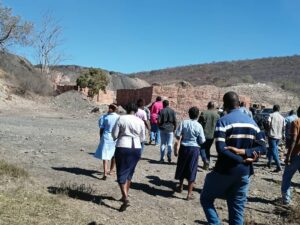
Chipinge Villagers part of the Bio Innovation Zimbabwe Baobab Processing Hub
Across Chipinge communities in Zimbabwe, villagers are turning indigenous fruit trees into a source of livelihood while safeguarding the environment.
Chipinge, Zimbabwe – The sun filters through the branches of a towering baobab as Tafadzwa Chirenje, a respected elder in Bangwe village, pauses to appreciate the tree’s rough, storied bark. “This tree,” he says, “has provided for our families for generations.”
The indigenous fruit trees that grow throughout their communities are more than just plants to him and his people; they are representations of resilience, cultural legacy, and economic potential.
Understanding that hasty exploitation would deplete these resources and leave his people vulnerable, Chirenje has long fought for the protection of the forests in his community. With support from World Agroforestry (ICRAF), Chirenje and his neighbours have worked to create a system of ownership, over wild fruit trees. This arrangement has allowed them to manage the trees responsibly, ensuring that they remain a renewable resource for future generations.
“I know that this baobab belongs to my family,” he says, proudly pointing to the tree. “We don’t strip it bare; we take only what we need. That way, it will keep giving us fruit and shade for many years to come.”
Chirenje’s leadership has inspired others. The Bangwe community has developed a culture of stewardship and pride in the forest, encouraging others to take charge of their natural resources. Villagers are starting to personally witness the financial and ecological advantages of sustainable management as more of them embrace tree tenure.
Adding Value to Indigenous Produce
In the Nyanyadzi area, Rudo Bvumbura (30) is a pioneer in value addition, transforming raw fruits from indigenous trees into marketable products. Her cooperative has found success by producing baobab and Ziziphus mauritiana (masawu), which can be mixed with milk to make yogurt or with water for a refreshing drink.
“We used to just sell the fruit raw,” says Bvumbura. “Now, we can make more money because people see value in the processed products.”
Bvumbura’s cooperative processes the fruits of trees like baobab and ‘Masawu’ and other edible local indigenous trees, turning them into flour, jams, and dried snacks. These value-added products fetch higher prices than unprocessed fruit and have allowed the villagers to access broader markets.
“We never imagined our baobab powder would reach people in the cities,” she says with a smile. “It’s helping us pay school fees, buy medicine, and support our families.”
The assistance of ICRAF has been crucial to this change. The group has helped the cooperative open up new revenue streams by offering training on marketing, packaging, and processing methods.
However, Bvumbura and her colleagues recognise that sustainability must be prioritised. Only a percentage of the fruit that is available is harvested, allowing the tree to regrow.
“We take care not to harvest too much,” she explains. “We run the risk of losing the trees that provide us with this opportunity if we take too much.”
Conservation Rules Passed Down Through Generations
In Nyanyadzi and Bangwe, the idea of forest conservation is not new. Traditional methods that safeguard their forest resources have been followed by the people for a long time. Kraal heads, enforce the tree-harvesting regulations. According to these unwritten laws, branches should be pruned sparingly to ensure the survival of the tree rather than the entire tree being felled for construction or fuel.
“Only in times of great need, like funerals, are we allowed to cut a whole tree,” explains Samson Rupango, a villager in Nyanyadzi.
He remembers learning these practices from his grandparents and emphasises their importance in maintaining a healthy forest.
“Our ancestors knew that if we used the forest carefully, it would provide for us forever. It’s up to us to honour their wisdom.”
However, these long-standing customs are susceptible to external influences in the absence of official legal recognition. These traditions are occasionally threatened by competing claims to specific forest areas and the growing demand for forest resources. For this reason, locals are pushing for official legal tenure over their common lands. Legal recognition, in their opinion, would enable them to efficiently manage their resources and shield them from outside exploitation.
These traditions are particularly important as Zimbabwe faces increasing deforestation. Illegal logging continues to be a danger as agricultural spreads into forested regions, driven by impoverished families’ pressing need for quick cash. Moreover, overlapping policies from multiple environmental laws sometimes create confusion over who holds authority over forest resources.
Educating the Next Generation
As the world changes, so too must the practices that safeguard Bangwe and Nyanyadzi forests. Community leaders are educating the next generation to make sure they comprehend the need of preserving forests.
Trees in these communities are stories to the elders. These indigenous fruit trees are more than just a feature of the landscape; they are the lifeblood of communities, offering not only food but also employment opportunities and a link to cultural legacy.
Under the shadow of a baobab tree, Chirenje always takes the time to talk to the kids about how their ancestors depended on these trees. He instills a sense of responsibility in the young people by demonstrating how to collect the fruits without damaging the tree.
“These trees have been here longer than us,” he says, touching the rough bark of a baobab tree affectionately. “They provided food, medicine, and shelter for our ancestors. We must safeguard them for future generations as well as for ourselves.”
He continues, “These kids are the future. They will continue our work if they understand why we protect the trees.”
Along with learning useful skills, the kids also gain a profound reverence for the land and environment. The community intends to develop a new generation of environmental stewards by incorporating them in workshops on grafting and tree planting.
ICRAF also provides technical support, teaching farmers how to preserve indigenous trees on their own land. In addition to enhancing forest conservation, this agroforestry strategy gives families access to more sources of income.
Laws and Stewardship
Under the Forest Act of 1954 (for gazetted forests) and the Communal Land Forest Produce Act of 1987 (for communal areas), the Forestry Commission is the official organisation in charge of regulating the use of forests in Zimbabwe. The Forestry Commission helps set and oversee quotas in privately owned regions, but the farmer makes management decisions. On the Forestry Commission’s recommendation, Rural District Councils draft concession agreements for community areas, which are thereafter overseen by the commission.
Residents of community lands are permitted to use any forest products for their own purposes under the community Land Forest Produce Act (chapter 19.04). In the process of clearing land for development, the occupiers are allowed to use any forest products, including reserved trees, on any area that they are allowed to use for residential or agricultural reasons.
The Natural Resources (1941) and Rural District Council (1988) Acts are the other laws that control the use of trees. Other authorities are given authority under the Forest Act to govern and establish institutions. The Forestry Commission is in charge of regulating the trade in forest products. Additionally, the Rural District Councils Act gives the District Council the authority to provide licenses for the use of forestry resources.
In an effort to protect their customs, the people of Chipinge have demanded more precise legal tenure for communal properties. Instead of leaving it to outside agencies that do not fully understand local customs, local environmental defenders contend that giving communities legal control over their forests will encourage sustainable management.
A sustainable future continues to be a clear goal for Bvumbura and her fellow villagers. “These trees give us more than fruit; they give us purpose,” she says.