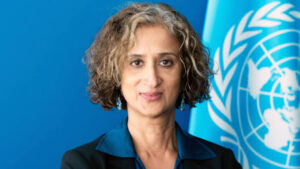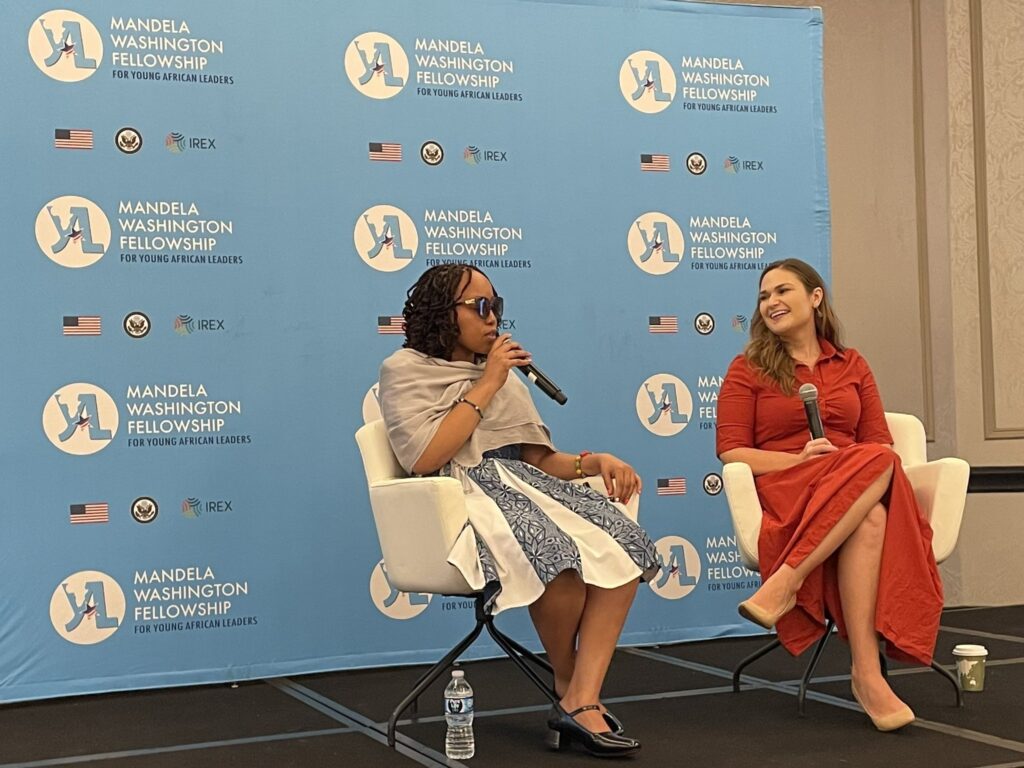
Fifi giving a presentation during the 2024 Mandela Washington Fellowship Summit. Credit - IREX
Countries around the world have been for the past years working towards creating safe environments for children, culminating in equal opportunities even for those with disability. On the Weekly Guest Show, Onita Sibanda (OS) is joined with Refiloehape (Fifi) Sesinyi to discuss about ‘Creating an inclusive Learning Environment for Children’.
OS: Welcome to the show Fifi, may you kindly introduce yourself!
RS: Greetings everyone. I’m Refiloehape (Fifi) Sesinyi from the beautiful mountain Kingdom of Lesotho. I am a young blind woman who strongly values and embraces the “lioness “philosophy. I am an Inclusion Ambassador, Gender and Disability Rights Activist, Assistive Technology Trainer, Social Work and Gender Studies Graduate and alumna of several program including YALI RLC-SA and Mandela Washington Fellowship. Thank you for having me on the program today.
OS: Wow! Fifi, thank you for that powerful introduction. Your impressive background and passion for inclusion, disability rights and gender advocacy are truly inspiring. We are honoured to have you share your expertise and experiences with us today.
Our topic today is *Creating an inclusive learning environment for children in SADC*. What are your thoughts on this?
RS: It is extremely important that a conducive learning environment is created for children in Southern Africa for them to grow and learn and later become active members of the society. Coming from the disability and gender rights advocacy space, I’m convinced that much is still needed to ensure that children who are negatively affected by power structures like gender, disability, class and location are accommodated in their uniqueness. I have witnessed a number of girls with disabilities from poor backgrounds dropping out of school because of pregnancies, which in most cases is a result of abuse.
For instance, in Lesotho, there are only two existing schools (1 primary and 1 high school) with well-established resource centres for the blind. Unfortunately, these schools are church schools with own policies, which do not allow mothers in schools. The schools further have limited assistive devices and reading materials, often forcing the visually impaired students to depend on other mainstream students for reading. This shows that, even if these students are talented the environment hinders them to excel. My point is, as the region we need to reconsider some of our beliefs, norms and practices since they inform some of the decisions and policies that are made. I admit there are some good policies within the region, however, many countries have a problem with implementation. The stereotypes we often attach to gender, disability and class influence the priorities and choices we make in different leadership positions. Since, learning intersects with several systems in the community, we all need to be intentional in including all children.
OS: Thank you, Fifi for sharing your insightful perspectives and personal experiences. Your passion for inclusive education shines through. The challenges you’ve highlighted in Lesotho’s education system are alarming, particularly the lack of support for visually impaired students and pregnant girls with disabilities.
You have been assisting women with disabilities in Lesotho. How has this been helpful to women and children under their custody?
RS: Women with disabilities are faced with unique challenges, often “doubly disabled”, because of their gender and disability. Empowering them means they are able to be independent and use their voices to challenge the existing oppressive power structures. After participating in educational, support and therapeutic groups sessions that I organize and facilitate, many have reported to have improved mental health, confidence and resilience. Imagine when the society considers you to be a burden, valueless and futureless because of your disability and your vulnerability as a woman. It hinders you to make any side-hustle, and you become a parent. Do you think you can forgive yourself or even love the child?
Empowering and amplifying the voices and experiences of these women also benefit their children. As parents, they have reported to be healing and are able to form a bond (attachment) with their children. Science has evidence that when children have positive bond, that has a benefit to their development and growth. This means that their children are able to have positive interactions with other children in different settings.
OS: Your words are powerful. The double disability faced by women with disabilities resonates deeply. Your work in empowering them is truly transformative. Thank you. What are the impacts of isolating children with disabilities in learning environments?
RS: There is a scientific evidence that disability is linked to poverty and poverty to disability. Excluding children with disability means that we are creating a continuous generation of poverty and disability. This does not only affect individuals and families, but also our countries and economies, since they would need to depend on social welfare. Also, excluding them we are killing gifts and talents that would advance the world. Have you thought about the contributions a blind child can make if given an opportunity to play a role where they have to use either their mind or voice or any other sense that become more activated due to loss of vision?
As the region, if we continue to see children with disabilities being excluded, we are definitely heading to the future where we will still be talking about discrimination and social injustices because a seed that children with disabilities are different or even inferior would have been continually planted in the mind of other children observing, because they are.
OS: Your emphasis on the potential of children with disabilities is inspiring. The notion that exclusion perpetuates discrimination and social injustices is a reminder of the urgent need for inclusive education.
Coming from the recently held SADC Summit! What do you think might be priorities on disability issues?
RS: I believe that inclusive accessible and equitable education should be a priority. This is because, education is foundational in achieving inclusion in all areas being: political participation, employment opportunities, peace and security, gender equality and all areas. We always say, “nothing for us without us”. So, inclusive equitable and accessible education is key in insuring that persons with disabilities can also have a sit on the table in decision making processes of matters that also affect them as members of the society. For example, the region can invest in assistive technologies as they play a key role in inclusion of persons with disabilities.
OS: That’s a powerful call to action Fifi, your points are well taken. Let’s talk of rehabilitation. In Lesotho there is only one rehabilitation centre. This reflects on policy in the country and can be similar across Africa. What have you been doing to advocate for the rehabilitation of visually impaired people?
RS: For a long time, I have been using various platforms including radio and television broadcasts and meeting with relevant stakeholders to advocate for policy change. However, in the advocacy process, I learned we need more of the community based rehabilitation. Taking persons with disabilities to rehabilitation centres give them the taste of inclusion. Unfortunately, the communities remain the same and they still feel excluded in their participation limited.
So, besides just advocating for more rehabilitation centres, which is a far fetched dream because of limited funding, I also advocate for the inclusion of the community in making the environment more accessible. I further include them in the trainings and workshops on inclusion and accessibility. For instance, they are taught, they can use alternative means like patching a tape on the floor in a factory house to help the blind navigate to different destinations, instead of excluding them with the rational that the space is too big and navigation may be difficult.
OS: Thank you Fifi, your holistic approach to advocacy is impressive. Community based rehabilitation and inclusive environments are crucial for sustainable change. Let’s talk of deaf-blind people. What form of support is needed for children in the same circumstances?
RS: I remember having the opportunity to learn American sign-language as a blind and being instructed by a deaf-blind individual. From the experience, I learned children with deaf-blindness requires patience, support and creativity. Imagine teaching children to dance and allowing the child to feel how you move your legs and hands, then touch their legs to communicate that they too should dance. It is very fulfilling to have someone communicate in your own language. Already many children learn easier when they play or physically engage with their environment. That is the similar perception one can have to accommodate these children. Touch, touch, touch, touch… everything is touch.
OS: Wow, your experience learning American Sign Language from a deaf blind instructor is truly enlightening. Also your description of teaching dance through touch is powerful. It highlights the vital role of communication in inclusive education. How do you see The Besana Mail supporting or working with children with disabilities?
RS: I see the Besana Mail amplifying experiences and stories of children with disabilities, challenging assumptions and questions the society has about children with disabilities. I see it having programs that connect these children across the region, giving them exposure an opportunity to be themselves without fear of being judged.
OS: Thank you Fifi, your vision for Besana Mail is inspiring. Amplifying voices and challenging societal assumptions will create lasting impact. Connecting children with disabilities across the region will foster a sense of community and belonging. Exposure and empowerment are crucial for breaking barriers.
Your last words?
RS: Everyone, who has made it in life has had, is having and will always have a supporting (helping) hands. Because of the existing social inequalities and injustices, children from minority groups require more support for the world to see and celebrate them. Who does not want to be see, honoured and be remembered through-out history? it is necessary that we become more intentional in empowering children from diverse backgrounds. There is no way the world will celebrate the resilience, skills and talents of children with disabilities if I, you and we do not extend a supporting hand and challenge the narrative. Every child is awesome, they just need eyes, ears and legs that will help them to see, hear and walk to places they never imagined. The world was structured by people like me and you, therefore, it is our responsibility to ensure that every child meaningfully participates in the shared future.
OS: Thank you so much Fifi, your passionate call to action resonates deeply. Empowering children from diverse backgrounds, especially those with disabilities, is crucial for a more inclusive future. Your emphasis on intentional support and challenging narratives is vital. Every child deserves to be seen, heard, and celebrated.
Fifi, your unique perspective and experiences have enriched our understanding. We’re grateful for your time and expertise. We wish you continued success in your advocacy. Your impact is invaluable. Thank you.