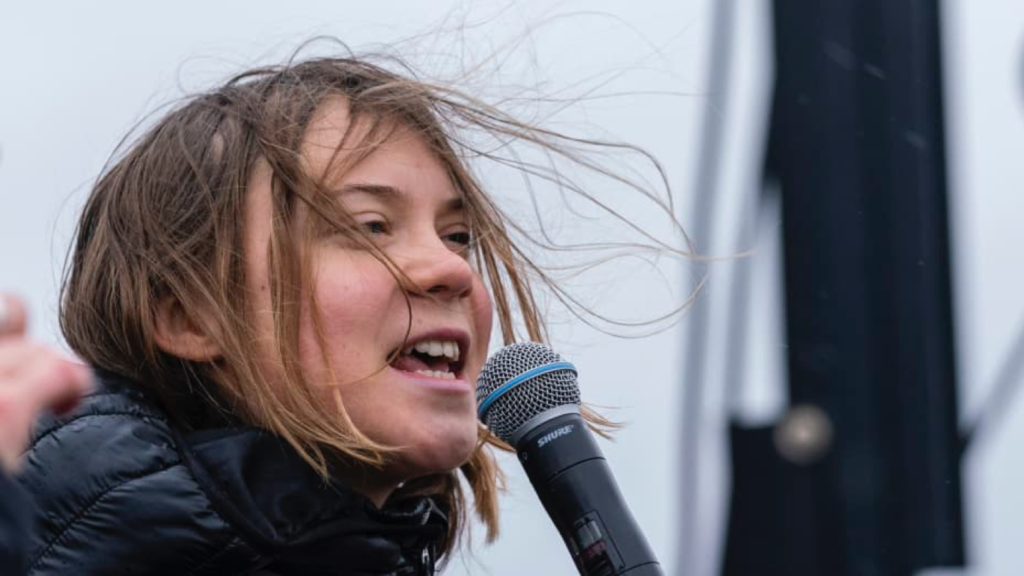
Earlier this year, Thunberg was arrested alongside other campaigners during a protest against the demolition of a small German village to make way for a coalmine. Bernd Lauter | Getty Images News | Getty Images
The ‘Greta Effect’ and role of children in the fight against climate change
On June 9, 2023, Greta Thunberg graduated from school, ending the Friday climate change demonstrations at schools but also starting a new chapter in her life. Swedish environmental activist Greta Tintin Eleonora Ernman Thunberg is famous for putting pressure on world leaders to act quickly to address climate change. She was born on January 3, 2003. In August 2018, at the age of 15, she started spending her Fridays outside the Swedish Parliament while carrying a sign that said, “Skolstrejk för klimatet” (School Strike for Climate). Soon after, other local kids began to protest in a similar manner. They co-organized a campaign for a school environment strike under the name Fridays for Future.
Shortly after Thunberg’s speech at the 2018 United Nations Climate Change Conference, student strikes started happening every week worldwide. In 2019, more than a million students participated in a number of coordinated demonstrations in various locations. In order to circumvent carbon-intensive air travel, Thunberg chose to fly to North America in the 60-foot (18-meter) racing boat Malizia I, which is equipped with solar panels and underwater turbines.
As evidence of Thunberg’s professed beliefs about the importance of reducing emissions, it was announced that the transatlantic voyage will be carbon-neutral. She attended the United Nations Climate Action Summit in New York in 2019. During her speech there, she uttered the words, “How dare you?” which were widely reported by the media and featured in songs.
Children in Zimbabwe are among the minority populations most affected by climate change. Water scarcity in rural areas has long been linked to droughts. However, the situation in urban areas during droughts is problematic since it depends on both the quantity of water and the quality of services provided by municipal government. In order to increase the amount of water available for domestic and agricultural use, UNICEF recommended updating waterworks, drilling more boreholes, fixing any that are damaged, and expanding the provision of municipal water in urban areas.
Cyclones and floods have both occurred in Zimbabwe. In 2019, Cyclone Idai destroyed most of the communities in the Eastern Highlands. In certain places, the extreme consequences of floods had a detrimental effect on children. the impact of climate change on children’s education. A UNICEF Zimbabwe study conducted after Cyclone Idai suggested that the government expand the reach of social protection interventions to ensure that all children attend school during extreme events and establish supplemental feeding programs for schoolchildren in regions susceptible to extreme weather events.
When Thunberg first learnt about climate change in 2011, she was eight years old and confused by the lack of action being taken to combat it. When she was eleven years old, she stopped talking and eating frequently because she was upset about the situation. In two months, she also shed ten kilograms (22 pounds). Thunberg fought depression for over four years before to launching her campaign for a nationwide school strike. To lessen the family’s carbon footprint and overall environmental impact, Thunberg pushed her parents to upcycle, go vegan, and stop traveling for about two years.
In January 2019, Thunberg said, “Our house is on fire,” criticising the political and economic elites for their inactivity on climate change at the annual World Economic Forum in Davos, Switzerland.
Numerous honors and awards have been bestowed upon Thunberg, including an honorary fellowship from the Royal Scottish Geographical Society, inclusion on Forbes’ 2019 list of the 100 most powerful women in the world, four nominations for the Nobel Peace Prize in 2019, 2020, 2021, and 2022, and recognition as one of Time’s 100 most influential people and the year’s youngest Person of the Year.
Thunberg has maintained that the Paris Agreement’s commitments are insufficient to keep global warming to 1.5 degrees Celsius and that the greenhouse gas emissions curve must start to decline sharply by 2020, as stated in the IPCC’s Special Report on Global Warming of 1.5 °C, which was released in 2018. According to her, the EU needs to cut its CO2 emissions by 80%, which is double the 40% target, because its existing plan to cut emissions by 40% by 2030 is “not sufficient to protect the future for children growing up today.” She said this during a European Economic and Social Committee summit in February 2019.
For her work, Thunberg has received both passionate support and harsh criticism from politicians and the media. Thunberg said she does not remember ever being impressed by any of the many politicians and international leaders she met.
According to Konrad Adenauer Stiftung (KAS) – Facts for Planners and Decision Makers, climate change would cause average temperatures in Zimbabwe to increase by roughly 3°C before the end of the century. Annual rainfall could drop by 5% to 18%, especially in the south. Rainfall will fluctuate more often. Droughts, floods, and storms will all increase. This would affect Zimbabwe’s economy, food supplies, security, well-being, and access to energy.
According to KAS’s research, if Zimbabweans are to survive climate change, they will have to adapt. According to the report, adaptation should involve strengthening human groups’ and ecosystems’ resilience to environmental shocks as well as implementing sustainable development strategies that prioritize social network fortification and improved natural resource management.
“Adaptation needs to be adapted to particular communities and ecosystems. Local communities should be the driving force behind it, working with development organizations with the backing of regional and federal government institutions. Initiatives for local adaptation should be based on native knowledge in addition to modern scientific and technology advancements,” said the report.
In a tweet last month, Thunberg threatened to keep fighting climate change and those responsible for it.
“I graduate from school today, so I will no longer be able to go on a school strike for the climate,” said Thunberg.
The 20-year-old shot to celebrity in 2018 after quitting school every Friday to participate in a vigil outside the Swedish Parliament. The 251st week of her protests at the school ended on Friday, June 9, 2023, with a warning that “the fight has only just begun.”
Thunberg’s action, which began as a single protest, would eventually lead to a mass call for climate change action. Millions of children participated in school strikes for the environment in more than 180 countries prior to the coronavirus outbreak in 2019, which forced the “Fridays for Future” movement to find alternative forms of protest.
“We have a responsibility to speak up when we can. We require everyone if we are to alter everything. Even though it is not officially “school striking,” I will still demonstrate on Fridays. There is really no choice except to take every action we can. The battle has just started,” said Thunberg.
After hearing Greta, thousands of international leaders, including then-British Environment Secretary Michael Gove, realised that tackling climate change was a priority.
“I felt a great sense of gratitude as well as regret and accountability as I listened to you. As someone who grew up before your parents, I know that we haven’t done nearly enough to address climate change and the broader environmental problem that we caused,” Gove added.
Earlier this year, Thunberg and other activists were arrested while taking part in a protest against the demolition of a German town to create space for a coal project.
Many of Thunberg’s school-age peers have experienced what has been called “the Greta effect.”
Read more stories: https://thebesanamail.com/2023/07/06/childrens-mental-well-being-and-the-role-of-psychotherapy/