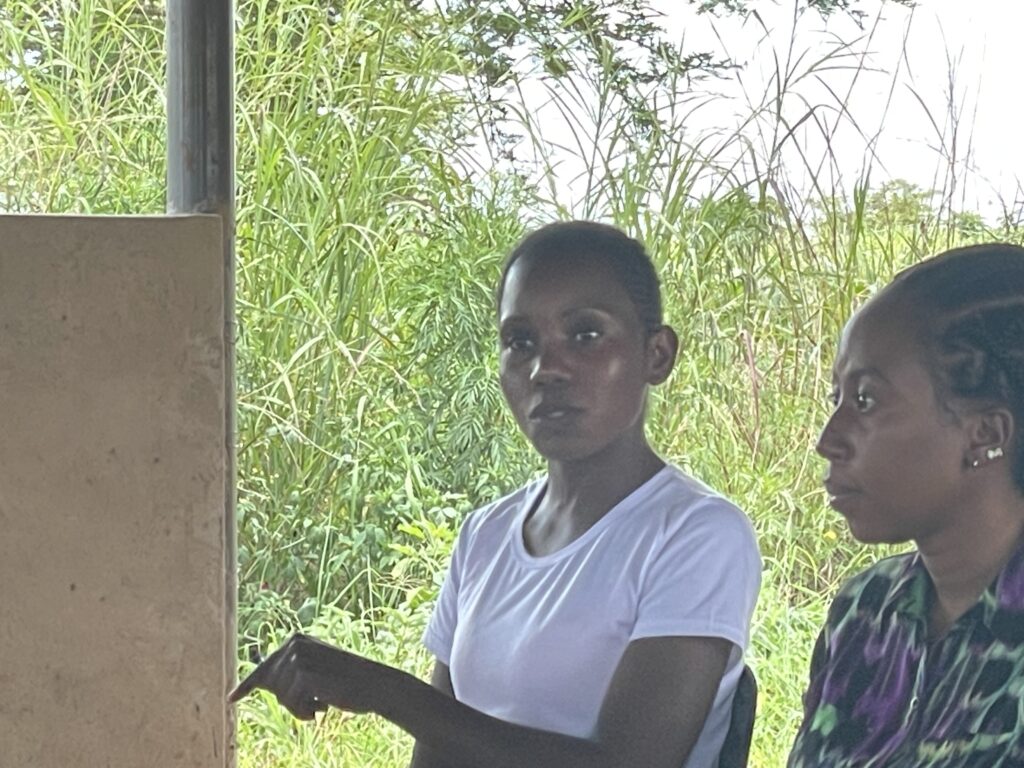
Delight Chireka (in white) sharing her story with the community in Chishawasha at a recent ZUJ Press Club
Chiweshe – In the quiet village, 10 kilometres after Glendale, near Major Farm, nestled amidst the rolling hills of Chiweshe, in Mashonaland Central Province, a young girl, Delight Chireka found herself thrust into adulthood at the tender age of 17. Her story, like many others in rural Zimbabwe, highlights the harsh realities faced by young girls caught in the vicious cycle of child marriage.
Delight remembers the day her life took a drastic shift with great clarity. She soon found herself wandering the empty streets well into dusk when her father sent her on an apparently innocent errand to buy fish. Unaware of the trap that lay ahead, she obeyed her father’s directions in spite of her protests and mounting uneasiness.
“Since it was late, I figured that every store would be closed. But I went because my father insisted,” Delight says. She had no idea that this seemingly insignificant task would permanently change the trajectory of her life.
Suspicions swirl around Delight’s stepmother, believed to have orchestrated the night-time excursion to expose Delight to potential suitors. In a community where girls as young as Delight are vulnerable to early marriages, such actions are not uncommon. Caught walking with a young man, Delight was promptly sent to live with her boyfriend, a decision made without her consent.
According to Delight, “I felt betrayed by my own family.” “But my boyfriend’s love and acceptance gave me comfort in the midst of the chaos.”
Delight struggled for five years with the demands of married life and the adult duties that were placed on her at such a young age. She remained strong and resolved to create a better future for herself and her child in spite of the challenges.
Amid the gloom of child marriage, Delight’s story is a ray of hope today. With the help of local organisations and community leaders, she has become a voice for girls’ rights, fighting to put a stop to the destructive practice that cost her her childhood.
“I refuse to let my past define me,” Delight shares. “I am determined to break the cycle of child marriage and empower other girls to dream big and pursue their aspirations.”
In contrast to Delight, the majority of young girls in Zimbabwe are married off and left to suffer.
Gender imbalance and the idea that girls are somehow less valuable than boys are the main causes of child marriage, according to Girls Not Brides, a global alliance that is working together to stop child marriage so that girls can reach their full potential. Speaking to the Zimbabwean context, the organization stated that poverty also makes child marriage worse.
“Daughters are occasionally married off to lessen their perceived financial burden, with families using the bride price (lobola) as a means of subsistence.”
The organisation said 50% of girls married before the age of 18 are from the poorest households in comparison to 14% of girls from the richest households.
According to Girls Not Brides, one of the reasons for Delight is family honour. This means that a female may be compelled to be married in order to alleviate any perceived or actual shame if she has premarital sex, is spotted with a partner, or arrives home late.
According to a study by Girls Not Brides, girls from the poorest homes in Zimbabwe are more likely than those from the wealthiest households to get married before turning 18. Many girls drop out of school because their parents cannot afford to pay school fees, which in turn puts girls at a higher risk of being married off. According to UNICEF, 66% of girls married before the age of 18 had none or pre-primary education, 57% had primary education and 5% had completed higher education.
Speaking at a community indaba in Chishawasha, Shamiso Mutape of the Farming Community Educational Trust (FACET) said that child marriage deprives girls of their right to be children and has a terrible effect on their life.
“It often leads to school drop-out, disallowing girls to develop their full potential and to early pregnancies when a girl is not mentally and physically ready to birth or take care of a young child. Child marriage also increases the risk of domestic violence, psychological and physical violence, including sexual violence, and HIV-infections,” said Mutape.
Recent studies by Amnesty International highlight the grave repercussions of child marriages and the numerous human rights abuses that young girls in Zimbabwe must endure. Early marriage has far-reaching and disastrous effects, ranging from sexual assault to interrupted schooling and restricted access to healthcare. Many girls are caught in a cycle of vulnerability and poverty, unable to make decisions regarding their health or further their education.
In response, Zimbabwe’s UN has adopted a proactive approach, coordinating its activities with the UN Sustainable Development Framework (2022–2026) to combat poverty and end destructive customs including child, early, and forced marriage. The UN seeks to stop child marriages and shield vulnerable girls from exploitation through programs like the Spotlight Initiative.
Local voices from Chishawasha echo these sentiments, emphasizing the broader societal implications of child marriage.
UN Women has praised legislation that raises the legal marriage age to 18 years old, acknowledging that it is crucial to enforce such rules in order to safeguard the rights of girls and guarantee their welfare. However, preventing child marriage necessitates a fundamental change in societal views and practices in addition to legislative reform.
“This is a major development that came as a result of years of evidence-based advocacy and we owe it to the girls of this country to enforce this law so that they can be seen for what they are: girls, not brides, not free labour, not commodities. Girls looking up to us to remove the many obstacles society has put on their pathways,” said UN Women Representative, Ms. Fatou Aminata Lo.
The advocacy organization FACET highlights the necessity of community-driven change and calls on parents, leaders, influencers, and children to speak out against child marriage. Millions of girls are still married off before turning 18, which feeds cycles of abuse and exploitation even though child marriage is now illegal worldwide.
According to Zimbabwe’s own statistics, a significant number of women and girls have been raped and sexually abused. According to UN Women, one in three youngsters in Zimbabwe were married before turning 18, a startlingly high rate of child marriages.
The Zimbabwe Gender Commission in 2019 reported that “Twenty-two women are raped daily in Zimbabwe, one woman is abused every 75 minutes and an average of 646 women are being sexually-abused monthly and one in three girls is raped or sexually assaulted before they reach the age of 18.
Even though more and more nations are steadily outlawing child and early marriages, 12 million girls or 23 girls every minute are still getting married before turning 18 every year.
While legal strides have been made, including the Supreme Court’s decision to strike down laws allowing child marriages, enforcement remains a challenge.
Section 22(1) of the Marriage Act, which for many years permitted children under the age of 18 to marry with parental consent, was overturned by the Supreme Court of Zimbabwe in 2016. In reality, child marriages have continued notwithstanding the Supreme Court’s ruling. This is despite Zimbabwe’s ratification of the Maputo Protocol, which forbids child marriages and any other detrimental cultural practices, including those involving minors.
Zimbabwe is a state party to both the African Charter on the Rights and Welfare of Children (ACRWC) and the United Nations Convention on the Rights of the Child, which uphold the principles of the child’s best interests, education, health, family protection, dignity, and freedom from sexual abuse and torture.