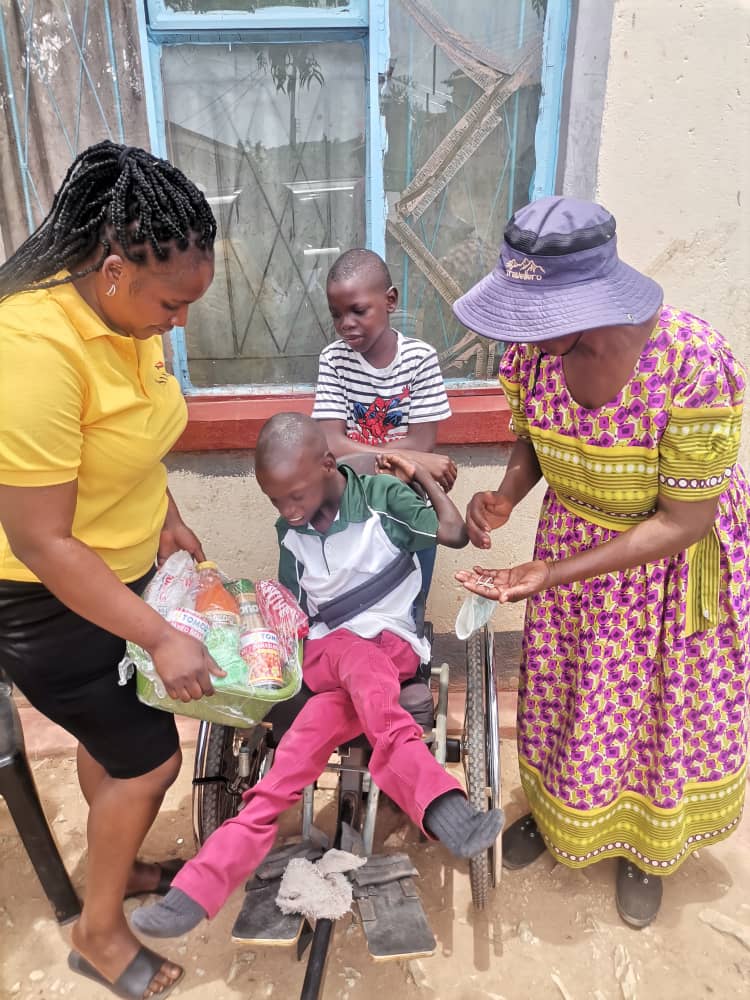
Sisonke Trust Founder - Nomantombi Ncube (Left) donating food hampers in Gwanda Town to children with disability
Without a disability friendly school in Gwanda, most parents are forced into separation with their children in search of inclusive facilities.
Gwanda – In 2008, Nomantombi Ncube gave birth to Keith Mpokuhle Ncube. Her son was born with autism. Six years later she enrolled her son at the nearest school within the community.
Ncube vividly recalls the day she got numerous calls from the school where her son was attending. At the pre-school, the teachers had no idea how to handle Keith.
Medical science defines Autism spectrum disorder (ASD) as a neurological and developmental disorder that affects the way people interact with others, communicate, learn, and behave.
The World Health Organisation (WHO) says about 1 in 100 children has autism. While some people with autism can live independently, others have severe disabilities and require life-long care and support.
The 16-year-old Keith cannot speak but hears. He has a kind of autism that is rare and cannot stay put for a long time, displaying an unusual behavior.
“I immediately knew this was not the kind of place my son was supposed to be learning. I had to look for an alternative,” said Ncube.
After noticing that her son needed special care and attention which he could not get from an ordinary public school. Ncube started searching for a special school in Gwanda, to no avail and had to look outside the town.
With Ncube’s father living in Bulawayo, the second largest city in Zimbabwe, she took her son there. In Bulawayo, Ncube’s son was enrolled at Jairos Jiri Early Learning Centre, a special school for children with disabilities for his primary education.
The school fees are expensive with the basic on US$500. However most of the government schools with special facilities for learners with disabilities accept the Department of Social Welfare assisted children.
“I have never struggled with fees because we applied at the Department of Social Welfare and our application was approved. The only burden is transport. We stay in Killarney and he goes to Sbantubanye Zimcare School for his secondary education which is on the other side of the city,” said Ncube.
Feeling at home
Children at special care schools find comfort and are set for success learning in a friendly environment coordinated with experienced teachers trained to work with people with disabilities.
“During the first month, I would go twice or thrice to see my son in Bulawayo. But when the boy was getting along with his grandfather, I reduced my visits,” said Ncube.
Ncube used to take her son to Gwanda during the holidays but but it was becoming stressful for Keith to adjust because of his condition. Keith’s condition requires special attention as he does not appreciate new faces. He only appreciates people and things he sees daily. When anything changes he becomes hyperactive and screams while closing his ears.
The family decided to leave him in Bulawayo and only Ncube visits him.
The prevalence of Autism Spectrum Disorder (ASD) in Zimbabwe is largely unknown owing to limited research in this area. According to a research by African Online Journals, unlike in developed countries, many individuals with ASD do not get the correct diagnosis early enough to promote timely interventions.
In his new environment Keith is doing well with notable improvement. He is now able to interact with other children.
WHO says care for people with autism needs to be accompanied by actions at community and societal levels for greater accessibility, inclusivity and support.
The mother’s burden
With her son 126 kilometers away Ncube found the separation hitting hard on her. Having witnessed the neglect of children with disabilities in schools and communities exacerbated by lack of disability friendly facilities, Ncube wanted to see children like Keith near their parents but in a safe and inclusive environment.
With a burden upon her heart she started helping other underprivileged children with disability with basic needs like food and clothing. Seeing change and the impact of her work, Ncube developed ideas to build a special school for children with disability who requires special treatment.
The Department of Social Welfare was her last stop as she could not proceed with her plans. The requirements were many and costly for a woman of her background with limited resources.
Ncube did not give up. In 2019, she founded and registered Sisonke Trust, an organisation set to end child poverty and establish relief centers for children who require special conditions. The registration of trust, then had less requirements compared to a special school.
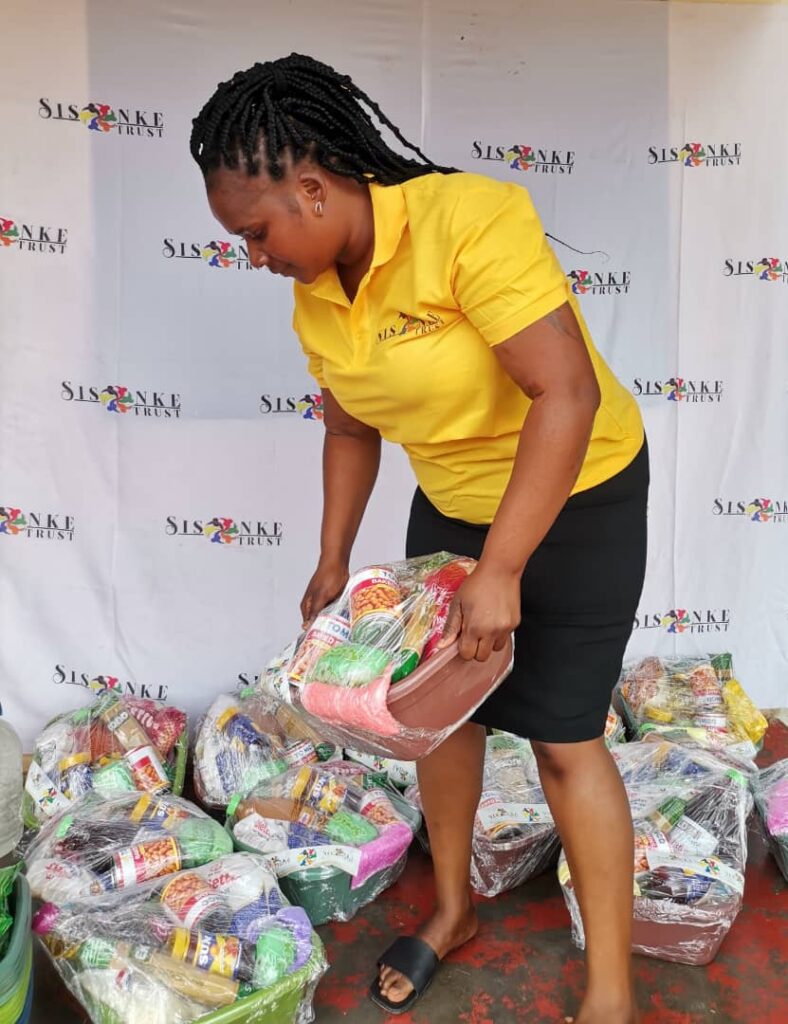
Ncube has managed consistently help 15 children with food, school essentials and sanitary items on several occasions.
Brilliance Gumbi, mother to Advocate Maphosa, one of the beneficiaries of Sisonke Trust said they have been receiving stationery and food items from the organisation which has been a great help to them as they cannot afford.
“While there are no special schools for children with disability in Gwanda at least there should be more awareness campaigns to enlighten other children in mixed schools about the conditions of children with disabilities. Sisonke is doing that and we are grateful,” said Gumbi.
Gumbi’s son usually faces bullying, a predicament faced by many children with such conditions in Zimbabwe and across Sub Saharan region.
According to UNESCO, students with special education needs refer mainly to learners with disabilities. The Education Act of 1987 states that every child shall have the right to school education.
A shoe string budget
Ncube had continued her operations on a tight budget and said it is difficult to keep the organisation functional without a donor, at the time they have limited resources.
Lack of support has been the only hindrance in achieving her dream of a special school. Ncube vows to continue her humanitarian work despite the challenges faced.
“Help does not necessarily need to come from organisations, but also from individuals, people should learn to check the wellbeing of their neighbors more often and assist with whatever they can,” pleaded Ncube.

Ncube looks forward to her blanket supply drive this winter, where she will be giving out blankets to people with disabilities.
Speaking to Ward 4 Councilor Wellington Nare said he appreciates the work by Sisonke Trust and efforts to assist children with disability. Since his election into the office Nare has not made any request of an inclusive school in Gwanda but said he has the idea to take the issue up at the council chambers and advocate for such a development.
“At Sisonke, they have a brilliant idea. I will take it up to the board and see how best we can start such projects to assist children with disabilities,” said Nare.