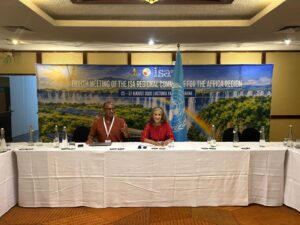
Prof. Caiphas Brewsters Soyapi - Associate Professor of Law at the North-West University, RSA.
As the world continue facing challenges of climate change, environmental degradation and unsustainable development, experts think it is essential that we prioritize the rights and interests of future generations. Onita Sibanda (OS) hosts Prof. Caiphas Brewsters Soyapi (CBS) to explore a crucial topic on Strengthening Intergenerational Equity on Environmental Rights for Future Generations.
O S: Welcome to the show it’s a pleasure to have you. May you kindly introduce yourself!
CBS: My name is Caiphas Brewsters Soyapi. A Zimbabwean native. Born in Kadoma but presently based in South Africa, where l am an Associate professor of Law at the North-West University. Thank you for having me.
OS: Thank you for the introduction. Can you explain the concept of environmental constitutionalism and its significance in Africa?
CBS: Sure! In general terms, environmental constitutionalism involves embedding environmental rights and responsibilities within a nation’s constitution. This ensures legal recognition and protection of environmental values. For example, South Africa’s Constitution explicitly guarantees the right to an environment that is not harmful to health or well-being and mandates the state to protect the environment for present and future generations. In Africa, this approach to environmental interests has been pivotal in promoting sustainable development and safeguarding natural resources. This is because African countries face the dual responsibilities of developing their nations for their peoples and protecting the environment for present and future generations. The challenge is that any development we can think of has a form of environmental impact, pollution or degradation.
OS: Thank you Brews for that insightful introduction to environmental constitutionalism. You have highlighted the importance of embedding environmental rights and responsibilities within a nation’s constitution.
How can the concept of intergenerational equity be applied to protect the environmental rights of future generations, including children?
CBP: It is not an easy task for sure, considering the challenges l have just mentioned. But perhaps, it is important to first contrast between intra-generational and inter-generational equity. Intra-generational relates to notions of fairness and justice across the communities and states within the present generation. Inter-generational equity speaks to the rights and obligations of the current and future generations regarding the use of the environment. Today’s children are tomorrow’s future. As to the specifics of intergenerational equity, we know that it emphasises fairness between current and future generations, and it ensures that today’s actions do not compromise the ability of future generations to meet their needs.
Applying this concept involves processes like sustainable resource management, reducing environmental degradation, and enacting policies that consider long-term environmental impacts. The clearest generic example l can give now is that implementing policies that limit carbon emissions to mitigate climate change reflects intergenerational equity by protecting the planet for future generations. In the context of Zimbabwe, prohibiting mining within protected areas, river banks etc., or avoiding giving long term mineral resource concessions are ways to at least be cautious in view of the interests of kids.
OS: Thank you for breaking down the concepts of intra-generational and inter-generational equity. Your examples, particularly the one about limiting carbon emissions and prohibiting mining in protected areas, help illustrate the practical applications of intergenerational equity.
I would like you to explore this further. How can we ensure that governments and policymakers prioritize intergenerational equity, especially when faced with short term economic pressures?
CBS: Economic pressures are the mischief to be honest. and in various countries in Africa they have been used to pursue rather dangerous (for the environment and the future) economic activities in the face of climate change. In countries with string judiciaries, some of these developments have been halted. That said, I would say that youth have a role to play on two fronts. First, through youth centered consultations. Most countries involve what we call green and white papers in legal and policy framework developments. The youth could mobilise around their interests when green papers are sent out. Most people ignore this. They could also mobilise around issues of public participation in decision making. For example, before any mining concession is given, and impact assessment must be done, and it must involve public consultations. They can let their voices known.
Secondly, they can be involved in activism. Just this month a High Court in South Africa stopped a coal plant development through what has come to be known as the “Cancel Coal case”. Here, youth were part of the activists.
OS: Thank you for highlighting the critical role of youth in environmental conservation, particularly in Africa. I’d like to build on your points. Are there any existing international or African frameworks that address the environmental rights of children?
CBS: Right. Well, there are not many legal documents that directly refer to the environmental rights of children. But we can infer such rights from many documents. If we generalise, we could say that any treaty supporting the right to life or health indirectly refers to a healthy environment, as without it, children’s interests are compromised. But we could also be specific and note that frameworks like the United Nations Convention on the Rights of the Child and the African Charter on the Rights and Welfare of the Child refer to what we call the “best interests of the child”. One could argue that the child’s best interests require that adequate and due regard is given to children’s interests in decisions that impact the environment. A good example here is that in its 2013 General Comment 15, the Committee on the Rights of the Child proclaimed that climate change is one of the biggest threats to the operationalization and enjoyment of children’s rights, and the interests of future generations.
OS: Thank you Brews for clarifying the importance of international frameworks and treaties in protecting the environmental rights of children. The connection you have made between the ‘best interests of the child’ principle and environmental decision making is particularly insightful.
How are children contributions incorporated into African environmental laws and policies?
CBS: I am not familiar with concrete examples within my space and research. I would say with a forward looking perspective, the two examples l mention above: public participation/youth consultations and activism will be key. That would be the case at least from a legal and policy dimension.
OS: That’s a great point, I appreciate your emphasis on public participation, youth consultations, and activism as key strategies for promoting children’s involvement in environmental decision making. These approaches can help ensure that children’s voices are heard and their interests are represented.
What role does environmental education play in empowering children to become future environmental leaders?
CBS: Great. Let me start with a legal provision, l think is very important. Article 11(g) of the African Charter on the Rights and Welfare of the Child states that “the education of the child shall be directed to: the development of respect for the environment and natural resources.” This is an imperative. There is a reason for it, and such is that environmental education equips children with knowledge and skills to address environmental challenges, while fostering a sense of responsibility and leadership on them. I know that a long time ago, around 2015 or so, the Environmental Management Agency (EMA) of Zimbabwe ran a school moot court competition on environmental rights. This was really forward thinking but for reasons l can never understand, they simply stopped.
OS: Great! Environmental education is essential for empowering children to address environmental challenges and fostering a sense of responsibility and leadership. How can environmental education be made accessible and inclusive for all children, regardless of their background or socioeconomic status?
CBS: For me, it is simple. It must be made part of the curriculum. Kenya is leading in Africa on this. It has a program around what is known as Eco-Schools, where students engage students in sustainable practices and are taught to be future environmental stewards around themes like water, energy, health, agriculture, biodiversity and waste etc. Where l grew up in Kadoma, there were Community-Based Learning centres that were open to everyone for learning.
I remember we had the JAIROS JIRI centre where everyone could go and learn about disabilities and how we should see beyond them. Same could be done for environmental issues. We also had a community library, which is now closed. We had multiple sections within that library where different information could be obtained. Access was for every community member. You just could not leave with a book. I would also say that there is a need to find ways to make environmental information useful to children, and that is through leveraging their interests, one of which is playing.
OS: That’s a great point. Integrating environmental education into the curriculum is crucial. Kenya’s Eco-Schools program is an excellent example of how this can be done effectively. I also appreciate your personal experience about the Community-Based Learning centres and the community library. These initiatives demonstrate the value of community led education and access to information. Your suggestion to leverage children’s interests, such as playing, to make environmental information more engaging is brilliant, storytelling, and hands on activities can be powerful tools in environmental education.
I would like to hear your reflection on the Listen to understand Ubuntu retreat, which took place in Hwange District in October. How can the concerns raised by the youths regarding climate change, unemployment and human wildlife conflict be addressed through a rights based approach that prioritizes the interests of future generations?
CBS: I believe the answers to this are still unravelling. But, first l would encourage those with capacity and time to look for a South African case called Gongqose and Others v Minister of Agriculture, Forestry and Others. It’s about protected areas and the role of communities around such areas in conservation. To the specific aspects related to the Retreat, on concerns around climate change, l would suggest beefing up the obvious: implementing policies that reduce emissions and promote sustainable practices. on the aspect of unemployment, one of the huge talking points globally is accelerated processes around green jobs and governments being deliberate about seeking green investments. On human-wildlife conflict, l think the idea around CAMP-FIRE remain timeless, but they require institutional and political will.
OS: Thank you Brews, for sharing your insights. Your suggestions for addressing climate change, unemployment, and human wildlife conflict are well taken. How can a media house like The Besana Mail effectively communicate and simplify environmental laws and policies for children?
CBS: I think you guys are doing a great job as it is. I would simply add that from what l have seen when engaging with communities, language could fail us. Farmers, for examples, might not understand the language of climate change, but they have indigenous ecological knowledge. This could be leveraged and infused with mainstream science. A platform like this could do with various other media, disseminating information through print, online, and social media and include a variety of methods to presenting information, including stories, videos, and pictures. I would also add that working with entities like the Zimbabwe Environmental Law Association can be useful, as they have mileage when it comes to dealing with the government and issues around activism.
OS: Thank you for your kind words and valuable insights. You made a crucial point about the importance of language and indigenous knowledge in environmental communication. Leveraging local ecological knowledge and combining it with mainstream science can be a powerful approach.
CBS: The same applies to children; one must source what interests them and catches their interests and then leverage that to provide relevant information. For me Playing does it. There is even an entity called Play Africa. Collaboration with such entities is useful.
OS: I’ll definitely take these ideas back to The Besana Mail team to enhance our environmental reporting and education efforts for children. I particularly like the idea of using storytelling and visual aids to make complex environmental concepts more accessible and engaging for young readers. We’ll explore ways to incorporate these strategies into our content.
Your last words?
CBS: Fantastic. That is the way to go. On that note, I’II end with the obvious. Kids are the greatest resource of any nation, and their interests must be prioritised and guarded jealously. This means that our immediate needs, as the current generation, must not be so blind and self-centred that we forget our actions have consequences. This is so true of environmental pollution because, to borrow the words of Rob Nixon, pollution and environmental degradation amount to “slow violence”. A kind of violence that does not manifest or show immediately but does so in time, perhaps even long after those responsible for the pollution and degradation are gone.
OS: Profound! Your conclusion is a powerful reminder of our responsibility to prioritize the interests of future generations. Professor Brewsters, thank you for joining us today and sharing your valuable insights on environmental education and sustainability. We appreciate the time you took to engage with us. We learned a lot, and I hope our audience took away some valuable lessons as well.