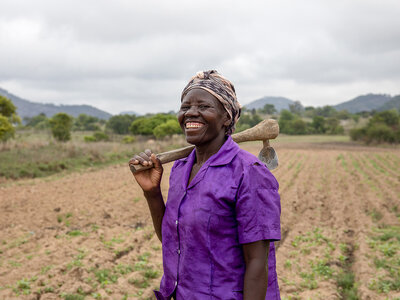
At sunrise in Mwenezi district, 38-year-old Memory Ndlovu presses her fingers into the soil where maize should be growing. The ground breaks apart like ash.
“It’s supposed to be green by now,” she says quietly. “But the rains stopped.”
Ndlovu is a smallholder farmer, a mother of four, and like millions of rural women across Zimbabwe, the backbone of her household’s food supply. But as climate change intensifies drought across southern Africa, her work has become a battle against forces far beyond her control.
The planting season began with hope. The first rains arrived in November, and Ndlovu planted maize, groundnuts, and sorghum on her small plot of land. Two weeks later, the rain stopped, for nearly a month.
Agricultural Extension officers say this pattern is becoming more common. Rising temperatures across southern Africa are increasing evaporation rates and disrupting rainfall cycles. Even when total rainfall for the season appears normal, long dry spells between rains can destroy crops before they mature.
In the case of Ndlovu, these changes translates into empty fields.
“If the rains don’t come back, we don’t harvest,” she says. “If we don’t harvest, we don’t eat.”
Ndlovu farms land that technically belongs to her husband’s family. Her husband works intermittently in South Africa, sending money when he can. In practice, she manages the farm alone, but without land ownership documents, she cannot access agricultural loans that require proof of tenure.
Women produce a large share of household food in Zimbabwe, yet many lack secure land rights, financial services, or decision-making power. When drought strikes, they have fewer resources to adapt.
Ndlovu explains her wishes, “If I had irrigation, I could still grow vegetables. But irrigation needs money.”
By mid-season, the family’s borehole had begun to dry. Ndlovu now walks nearly five kilometers each morning to collect water. The trip takes more than two hours.
Her daughters sometimes miss school to help.
“When there is no water nearby, everything becomes difficult,” she says. “Cooking, washing, even drinking.”
Food shortages bring other sacrifices. Meals shrink from three per day to one or two. Protein disappears first, meat, eggs, beans replaced by sadza with leafy vegetables when available.
Research shows women often reduce their own food intake during shortages so children can eat. Ndlovu admits she does the same.
“A mother cannot watch her children hungry,” she says.
Zimbabwe’s drought cycles have always existed, but climate change is intensifying them. Warmer temperatures mean soils lose moisture faster, crops experience more heat stress, and growing seasons become less predictable.
Smallholder farmers without irrigation, lives in chronic uncertainty.
Men often migrate in search of income during bad seasons, leaving women to manage farms and households alone. Ndlovu’s husband has been away for eight months.
“I must be strong,” she says. “There is no choice.”
Last year, Ndlovu joined a local women’s farming cooperative supported by an agricultural extension program. She learned conservation farming techniques: planting basins that trap water, mulching to retain soil moisture, and using drought-tolerant seed varieties.
The methods helped during the previous season. This year’s drought is harsher, but she still hopes for partial harvests.
Experts say empowering women farmers like Ndlovu is one of the most effective climate adaptation strategies available. When women have equal access to land, training, and finance, farm productivity increases and household nutrition improves.
“But access remains uneven and women suffer most,” said Innocent Chauke, an Agricultural Extension Officer.
As the sun climbs higher, Ndlovu still has to collect firewood before afternoon heat peaks.
“People say climate change,” she says. “For us, it means suffering. But we continue because we must live.”