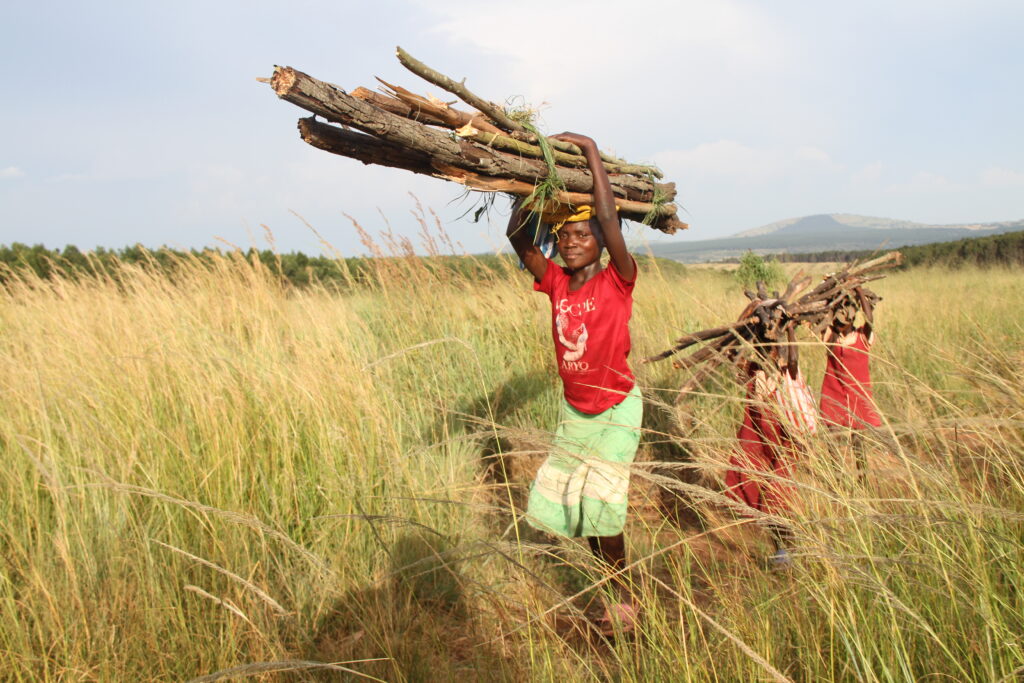
At the edge of a thinning woodland in Gokwe North, 42-year-old Rudo Chikore pauses to catch her breath. A bundle of dry branches lies at her feet, still too small to carry home. She wipes sweat from her forehead with the corner of her skirt and scans the landscape for more fallen wood.
Ten years ago, she says, this area was dense with trees.
“Back then, I could collect enough firewood in less than an hour,” she recalls. “Now I walk half the day.”
In this part of the world, climate change is not experienced through rising temperature graphs or scientific reports. It is felt in aching backs, smoky kitchens, and the growing distance between home and the natural resources needed for survival.
Nearly 70 percent of Zimbabwe’s population relies on biomass, primarily firewood, for cooking and heating. In rural communities, electricity access remains limited, and alternative fuels such as gas are often unaffordable.
But climate change is intensifying pressure on already fragile ecosystems. Rising temperatures and prolonged droughts reduce tree growth and increase vegetation die-off. When rains fail, communities also depend more heavily on forests for income, cutting wood to sell in nearby towns.
The result is environmental degradation accelerating fuel scarcity, forcing households to harvest remaining trees even faster.
“We go farther every year,” Chikore says. “Sometimes you reach a place and find nothing left.”
Climate scientists warn that southern Africa is warming faster than the global average, increasing evaporation and soil dryness. Available data shows that, this rapid warming, already exceeding 2°C in some areas, threatens to collapse staple food systems like maize and cattle farming by mid-century.
These conditions weaken forests and reduce regeneration capacity, especially in semi-arid regions like Gokwe.
In most rural Zimbabwean households, collecting firewood is considered women’s work. Girls often begin helping their mothers from a young age, carrying smaller bundles until they are strong enough to transport heavier loads.
In the same village Chikore’s 14-year-old daughter, Tariro and her friends sometimes accompanies their mothers in the long walks.
“I don’t like her coming,” Kudzai Muvenga says. “But alone it is too much.” Muvenga is a mother of three and a neighbour to Chikore.
Hours spent searching for fuel reduce opportunities for income-generating activities. Energy poverty, therefore, becomes a gender equality issue.
Development researchers describe this as “time poverty”when the unpaid labor required for household survival limits women’s economic and social opportunities.
In Gokwe and other parts of rural communities, the burden does not end once the firewood is collected.
Cooking over open fires exposes women to high levels of indoor air pollution. Smoke from burning wood contains fine particulate matter that penetrates deep into the lungs and bloodstream.
Experts including Max Healthcare say, long-term exposure is associated with chronic respiratory disease, eye irritation, heart problems, and complications during pregnancy.
“Sometimes my chest feels tight,” Muvenga says. “But what can I do? Children must eat.”
Young children face additional risks because they often remain near their mothers while meals are prepared. Health experts link household air pollution to pneumonia, one of the leading causes of child mortality globally.
“Climate change indirectly worsens these health risks. As wood becomes scarcer, households sometimes burn lower-quality fuels such as crop residues, dung, or wet wood, which produce even more smoke,” said Charles Pfaira, a pediatrician.
Community conflicts sometimes emerge as resources decline. Competition over remaining woodland areas has led to disputes between villages or households.
“People fight over trees now,” Chikore says quietly. “Before, there was enough.”
Despite these challenges, potential solutions exist. Improved cookstoves designed to burn wood more efficiently can reduce fuel consumption by up to 50 percent while producing less smoke. These stoves are now available at a reasonable cost.
Several NGOs have introduced fuel-efficient stoves in parts of rural Zimbabwe.
“It uses less wood,”Chikore says. “But we still need wood.”
The stove reduced her fuel demand, but it did not eliminate the need for collection. Upfront costs remain a barrier for many households, and cultural cooking preferences, such as the need for large pots during community events, sometimes limit adoption.
According to CEIC Data, Zmbabwe’s annual greenhouse gas (GHG) emissions are approximately 26 to 31 million tonnes equivalent, representing a very low share of roughly 0.06% to 0.1% of global emissions. Emissions per capita are low, at around 1.9 tonnes, with the primary sources being agriculture, land-use change, forestry (54%), and energy (33%).
Despite Zimbabwe contributing such a tiny fraction of global greenhouse gas emissions, it’s the communities facing mounting climate impacts. Within those communities, gender roles determine who carries the heaviest burden.