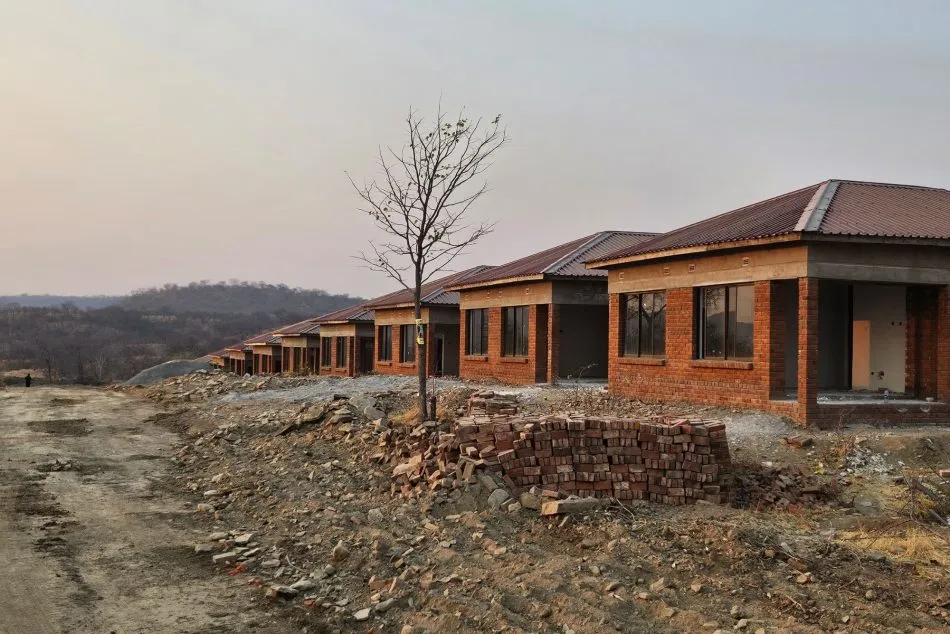
House construction in Harare, Zimbabwe. Pic Credit - Zim Build Group
In Madokero, one of the fast-expanding suburbs in Harare, Zimbabwe’s capital, newly built houses stand pristine behind high brick walls. Many of these houses have solar installed as they await being connected to the national grid, some as backup from erratic electricity supply. Inside one of these houses, the owner is counting losses.
A week earlier, thieves slipped in overnight and stripped copper wiring, a solar inverter, and fittings that had taken months of savings and remittances from relatives abroad to assemble. The house was partially insured, a lesson, Providence Chirwa says now, was expensive.
Incidents like these are becoming increasingly common across Zimbabwe, where a remarkable home-construction boom is reshaping many sectors of the economy, including the country’s insurance industry. With the rise of housing construction in a volatile economy, homeowners are confronting a hard truth.
“Building a house is no longer the end of financial risk, but the beginning of it. I lost more than USD5000 in material overnight when thieves broke into my house. Though too late, it was a wake-up call for me to insure not only my property but everything involved,” said Chirwa.
Zimbabwe’s home-construction surge is creating fertile ground for a boom in home or property insurance, as new homeowners grapple with losses and insurers scramble to meet a growing demand.
Over the past two years, Zimbabwe’s residential property market has accelerated at a pace few predicted. Developers have reported record sales. WestProp Holdings, one of the country’s largest listed property firms, posted an 80% jump in revenue in its 2025 financial year, driven overwhelmingly by housing demand. Across the sector, investment in real estate climbed to nearly $2 billion in 2024.
According to industry experts, this signals renewed confidence in property as a long-term store of value in a country where savings have repeatedly been eroded by inflation and currency instability.
Realtors and economists alike project that the residential property market could reach an estimated $85 billion by the end of 2025, with growth expected to exceed 5% annually through the end of the decade. Behind the numbers, there is rapid urbanization, a young and expanding population, diaspora-funded construction, and a cultural preference for tangible assets over financial instruments.
“In Zimbabwe, owning a home is not only an aspiration, but it is also a hedge in the form of a fixed asset. This is one area most Zimbabweans feel safe in the long run, which translates to the boom we are witnessing,” said Chris Hungende, a Harare-based real estate agent.
The building spree has also widened risk exposure. Homes are rising in new suburbs faster than policing can keep up. Construction often proceeds in stages, leaving materials vulnerable to theft for months. Climate shocks are becoming more frequent, with violent storms ripping off roofing sheets or flooding unfinished foundations.
With power cuts stretching for up to 18 hours a day, households are installing solar systems, lithium batteries, and inverters that can cost more than a small car, attracting criminals and being expensive to replace.
These pressures are pushing a growing number of homeowners toward insurance, turning what was once a niche product into one of the most promising growth areas for Zimbabwe’s insurers.
“In many scenarios, the shift toward insurance is triggered not by marketing campaigns, but by loss. Home insurance is expanding from a low base, driven by heightened awareness of theft, fire, and weather-related risks, as well as the steady rise of a middle-income homeowner class, many of them financed by relatives working in South Africa, the UK, or Australia,” Charles Mpala, an economist and part-time lecturer at Lupane State University, told The Besana Mail.
In some cases, homeowners have watched half-finished houses demolished by local authorities for zoning violations or title disputes, wiping out years of investment in a single day.
Economists said inflation magnifies the pain. The cost of replacing stolen or damaged materials can double within months, especially when imported inputs are involved. In the obtaining environment, insurance has become less a discretionary purchase than a financial firewall.
“People realise too late that rebuilding is no longer affordable,” said Charles Monda, an investment advisor. “Once you lose something, you can’t just go back to the hardware store and buy it again.”
Insurers are adapting to meet the emerging risks and growing demand. Policies that once focused narrowly on completed structures are being redesigned to cover homes under construction, building materials on site, fixtures and fittings, and increasingly, high-value household contents.
Comprehensive packages now include protection against fire, lightning, explosions, storms, floods, theft and vandalism, with optional extensions for accidental damage from burst pipes or falling trees. Liability cover, which protects homeowners if someone is injured on their property, is also gaining traction as suburbs densify.
Itayi Chakanyuka, an underwriter with GeneInsure, said that as a sector, there is an opportunity to grow and expand home insurance. He described it as a rising market.
“Home insurance has been lagging for many years compared to other lines of business, like motor and fire insurance. It was treated as elite, but now, we are witnessing a surge in construction and an appetite by homeowners to cover the risks. This is from ‘all’ across the board, and it is encouraging,” said Chakanyuka.
Banks are bundling home insurance with mortgages or construction loans, while some developers are encouraging buyers to insure properties from the moment foundations are laid.
Insurers such as Old Mutual, Stanbic Bank, CBZ Holdings, Cell Insurance, and Zimnat Insurance are leading in home insurance, offering policies for both local residents and the diaspora, often through digital and comprehensive options.
Despite the significant opportunity, insurance penetration in Zimbabwe remains low, reflecting decades of mistrust rooted in past claims disputes, currency conversions, and policy lapses during periods of hyperinflation. Many homeowners still view insurance as an unnecessary cost or fear that payouts will not keep pace with replacement values when disaster strikes.
Climate-related risks are no longer abstract, and crime remains a daily concern in expanding urban fringes. At the same time, financial literacy is improving, particularly among younger homeowners who are more comfortable with digital financial products.
“People still have fear, or rather, a lack of trust. Those building incrementally, paying monthly premiums on an unfinished structure, can feel like a luxury. But, the reality is dawning upon everyone that seeking home insurance is needful,” said Mhonda.