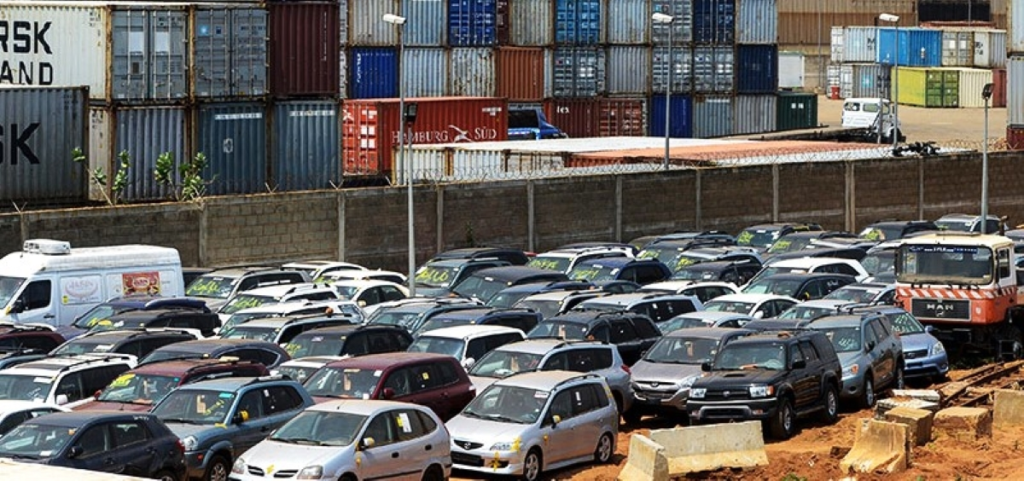
Used Japanese cars in Dar-es-Salaam, Tanzania
A consignment of Japanese vehicles bound for Zimbabwe and other countries was destroyed during protests in Tanzania late 2025. Stakeholders in the insurance sector said, the incident underscored the growing exposure of insurers and logistics firms to political unrest along key African transit corridors.
The vehicles, which were being transported overland after arriving at the port of Dar es Salaam, were torched when demonstrators blocked roads and set fire to cargo trucks during clashes with security forces. No fatalities were reported on the transporters, but the incident triggered multiple insurance claims and renewed scrutiny of political violence cover in one of Africa’s busiest trade routes.
Dar es Salaam serves as a critical gateway for landlocked economies in Southern Africa, including Zimbabwe, Zambia, Malawi, and the Democratic Republic of Congo. Disruptions along the corridor can ripple across supply chains, delaying deliveries, inflating costs, and exposing insurers to losses that are difficult to price amid rising social unrest.
The destroyed vehicles were reportedly covered under marine cargo insurance extended to inland transit, with additional political violence clauses. While standard cargo policies typically exclude losses arising from riots or civil commotion, many exporters and importers operating in higher-risk jurisdictions opt for add-ons such as Strikes, Riots and Civil Commotion (SRCC) or broader political risk insurance.
“Claims from politically motivated violence are becoming more frequent, and insurers are having to reassess both pricing and appetite,”said Maxwell Goche, an underwriter with exposure in East and Southern Africa.
“Transit routes that were once considered relatively stable are now seeing intermittent flashpoints.”
Industry sources estimate the value of the destroyed vehicles at tens of thousands dollars, depending on the mix of commercial and passenger units. Japanese manufacturers dominate Zimbabwe’s vehicle import market, particularly for second-hand cars, which are shipped in bulk through Tanzania before being transported south.
The protests in Tanzania, driven by domestic political and electoral grievances, came at a time when insurers are increasingly alert to spillover risks from localized unrest. While Tanzania has long been viewed as one of East Africa’s more stable economies, last year’s demonstrations challenged that perception, particularly for underwriters focused on transit risk rather than country risk alone.
“Political risk is no longer confined to destination markets,”said Fredrick Chimanikire an Africa-focused risk analyst at Eaglemate, a Leicester-based brokerage. “For insurers, the journey matters as much as the endpoint.”
The incident also raised questions about aggregation risk, the concentration of high-value cargo moving through single corridors. Dar es Salaam handles a significant share of vehicle imports for the region, making it a focal point for insurers concerned about systemic losses.
The destruction of the cargo translated into longer delivery times and higher insurance premiums for Zimbabwean vehicle importers. Some traders said they had already been notified by insurers of potential adjustments to transit cover for routes passing through protest-prone areas.
“We were told to expect higher excesses or additional political risk premiums,” said Tariro Chawatama, a Harare-based vehicle dealer who imports cars from Japan. “Those costs eventually pass to consumers.”
Zimbabwe relies heavily on imports for its vehicle market, with limited domestic manufacturing. Any disruption in supply chains can quickly affect availability and pricing, particularly for commercial vehicles used in mining, agriculture, and logistics.
The losses are also filtered through to the global reinsurance market, where African political violence risks are often pooled. Reinsurers have already been tightening terms following a rise in claims linked to protests, strikes, and election-related unrest across parts of Africa, Latin America, and Asia.
“Events like this contribute to a broader recalibration of political violence risk globally. Even if the absolute loss is modest by global standards, the frequency trend is what concerns us,” said Chimanikire.
According to industry data, claims related to strikes, riots, and civil commotion have increased steadily over the past five years, driven by inflation, economic inequality, and political polarization. Africa has accounted for a growing share of these claims, particularly in urban centers and along major trade routes.
Transport and logistics companies operating along the Tanzania–Southern Africa corridor are also reassessing security arrangements, including the use of convoy systems, real-time tracking, and alternative routing through Mozambique or South Africa, options that can add both time and cost.
“Rerouting is not always feasible, but insurers are increasingly asking what risk mitigation measures are in place,”said Caswell Mwembe, the regional manager of a logistics firm operating between Dar es Salaam and Harare.
Some insurers now require detailed route risk assessments before binding cover, particularly for high-value cargo such as vehicles, electronics, and fuel.
The claims that arose from the burned vehicles are expected to test policy wordings, especially around definitions of riots, civil commotion, and politically motivated acts. Disputes over coverage are not uncommon in such cases, particularly where protests escalate rapidly and involve mixed motives.
Legal experts say clarity in policy language will be critical as insured parties seek compensation.
“Political violence claims often sit in grey areas,” said Jasper Gadzikwa, an insurance lawyer specializing in emerging markets. “How the incident is classified can determine whether a claim is paid in full, partially, or not at all.”
At least for now, insurers say the Tanzania incident is unlikely to trigger an immediate withdrawal of cover for regional transit routes. However, it adds to a growing body of evidence that political and social risks are becoming a structural feature of global trade, one that insurers can no longer treat as exceptional.
“We’re moving into an era where disruption is the baseline,” said Goche. “The challenge is pricing that risk without making trade prohibitively expensive.”
As claims are processed and losses quantified, importers, insurers, and reinsurers alike will be watching closely, not just for the outcome of this incident, but for what it signals about the future of insuring trade across politically volatile corridors.