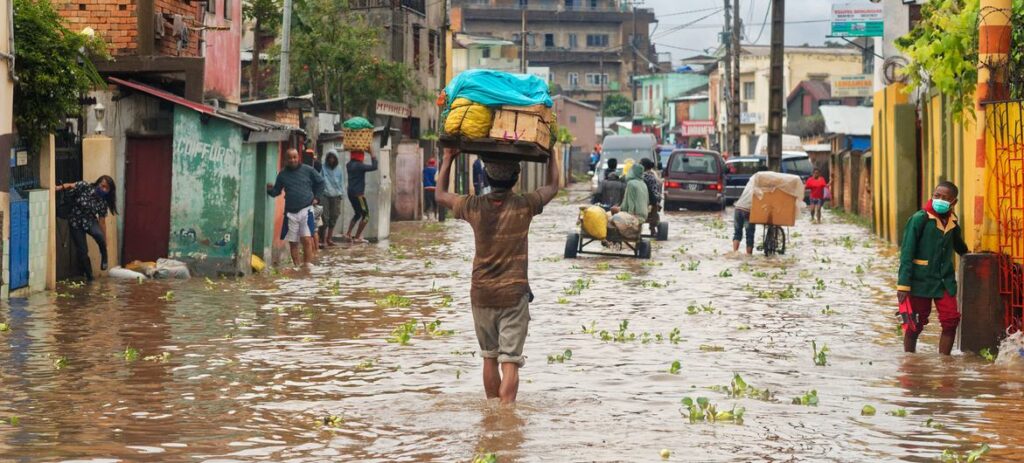
ANTANANARIVO – At least 6,000 children have been displaced and nearly 29,000 are unable to attend school after Cyclone Gezani tore through eastern Madagascar last week, compounding the devastation from an earlier storm and leaving tens of thousands cut off from essential services.
The cyclone made landfall on 10 February in the coastal district of Toamasina II, near the port city of Toamasina, packing wind gusts of up to 250 km/h. It was the second major storm to hit Madagascar in just two weeks.
Preliminary reports indicate that more than 270,000 people have been affected and over 16,000 displaced, many of them children. In the worst-hit Atsinanana region, damaged homes have forced families into overcrowded shelters, heightening the risk of family separation, exploitation, violence and psychological trauma among children.
“Many families have lost their homes, which turns into a deeply distressing experience for children. The cyclone has also disrupted essential services they rely on, including safe water, healthcare, protection, and schooling,”said Christine Jaulmes, Representative of UNICEF in Madagascar.
Power outages have crippled water systems in Toamasina, increasing the threat of waterborne diseases. Both university hospitals in the city were affected, while 21 health centres sustained damage. In two facilities, vaccine cold-chain systems were disrupted, limiting access to life-saving immunisation services.
The education sector has been particularly hard hit. Authorities report that 35 schools were damaged, 563 classrooms lost their roofs and 218 were completely destroyed, leaving thousands of children without safe learning spaces.
The response is being coordinated by Madagascar’s National Bureau for Risk and Disaster Management (BNGRC), with support from humanitarian partners. UNICEF began emergency operations before the cyclone made landfall and has since scaled up assistance.
According to UNICEF, so far, water purification supplies have reached 2,400 people, hygiene kits have been distributed to 178 households, and 2,000 mosquito nets delivered to 1,000 families. Emergency health kits sufficient for 60,000 people for one month have been deployed, and temporary learning spaces are being established to accommodate up to 14,000 students.
Public awareness campaigns are also under way, promoting safe water and hygiene practices, breastfeeding and nutrition guidance, and protection services for children. Families have been encouraged to use the toll-free hotline 930 to report protection concerns and access support.
The crisis comes as Madagascar continues to recover from Cyclone Fytia earlier this month and grapples with an ongoing Mpox outbreak in the north-west of the country, further stretching national response capacity.
Initial emergency efforts were supported by nearly US$900,000 from the Central Emergency Response Fund (CERF), allowing agencies to act before the cyclone struck. However, humanitarian needs remain acute. Meanwhile, UNICEF is appealing for US$8.4 million to scale up life-saving assistance and support early recovery for affected children and communities.