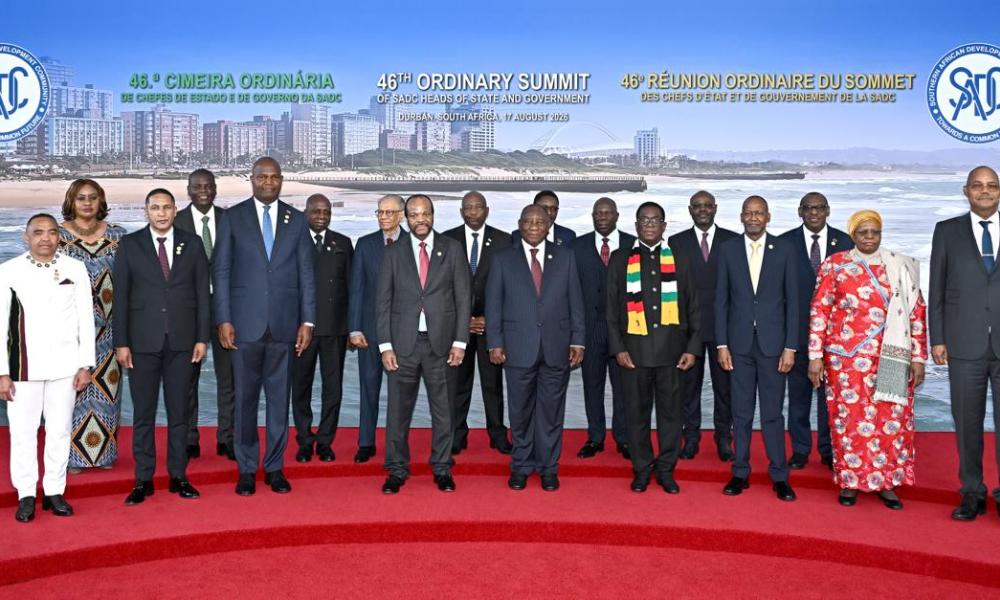
South Africa – By the time Southern African leaders gathered in Durban for the 46th Southern Africa Development Community (SADC) Summit, the region’s development problem was not a shortage of plans.
There were already strategies for industrialisation, regional integration, agricultural transformation, energy transition and infrastructure development. What came through strongly during the summit was a recognition that the region now needs to concentrate its limited resources on a smaller number of priorities and, crucially, get them implemented.
That is the significance of the summit’s theme: “Resilient, Sustainable, and Inclusive Industrialisation through Infrastructure Development, Agricultural and Critical Minerals Transformation in Pursuit of a Just World.”
It was not simply another broad development slogan. The decisions adopted in Durban put infrastructure, agricultural production, regional value chains and critical minerals at the centre of SADC’s next phase.
The summit endorsed the findings of the mid-term review of the Regional Indicative Strategic Development Plan 2020–2030, which recommends that SADC identify a limited number of high-impact priorities. Among them are industrialisation, resource mobilisation, regional value chains, agro-processing, critical minerals, a just energy transition, economic corridors, one-stop border posts and health financing.
That narrowing of priorities may prove more important than the rhetoric around the new chairmanship.
SADC has spent years attempting to deepen economic integration among its member states, but implementation has often been slowed by infrastructure gaps, different national regulations and barriers to trade across borders.
The summit directly acknowledged some of those problems.
On agriculture, leaders urged member states to remove non-tariff barriers, harmonise standards and improve cross-border logistics so that food can move more efficiently from countries with surpluses to those facing shortages. The objective is not only to increase regional trade but also to help stabilise food supplies and prices.
That is a practical issue for a region that remains exposed to climate shocks.
The summit also called on member states to prepare for anticipated El Niño-related climate shocks through stronger early-warning systems, drought preparedness, climate-smart agriculture, irrigation and drought-tolerant crops.
The agricultural discussion therefore sits squarely within the summit’s wider industrialisation agenda. For SADC, industrialisation cannot simply mean factories and mines. Member states defined it as producing more food, processing agricultural commodities within the region and building the infrastructure needed to move those products across borders.
Critical minerals were another major part of the conversation.
Southern Africa possesses substantial mineral resources needed by global industries, including those associated with the energy transition. But the challenge for the region is moving beyond the extraction and export of raw materials.
The summit’s endorsement of regional value chains, agro-processing, critical minerals and a just energy transition points towards a model in which SADC countries seek to capture more value from the resources they produce. That ambition will depend heavily on infrastructure.
The summit therefore urged progress on the SADC Regional Development Fund, calling on countries that have not yet ratified the agreement establishing the fund to do so. The aim is to improve resource mobilisation and accelerate regional infrastructure, industrialisation and socio-economic development projects.
Another potentially significant decision was the approval of the SADC Tourism UNIVISA agreement. Leaders called for member states to sign the agreement, arguing that easier movement across participating countries could increase tourism, investment and regional integration.
The summit also recognised that regional integration requires countries to actually adopt and implement the legal instruments they have negotiated. Leaders urged member states to accede to SADC instruments already in force and accelerate the signing and ratification of those still awaiting entry into force. The emphasis on implementation was visible beyond economics.
On the Democratic Republic of Congo, SADC reiterated its support for coordinated regional and international efforts to restore peace and security, protect civilians, strengthen humanitarian, public-health responses and promote inclusive dialogue.
On Madagascar, where political upheaval had disrupted the normal SADC chairmanship cycle, leaders welcomed the work of the SADC Panel of Elders and reaffirmed support for reforms aimed at inclusive governance, democratic institutions, accountability, human rights and a return to constitutional normalcy.
The summit also approved the appointment of former Botswana president Mokgweetsi Masisi and former Mozambican president Joaquim Chissano to the SADC Panel of Elders, strengthening the bloc’s mediation and conflict-prevention capacity.
There were decisions with a more immediate public-health dimension too. With the region dealing with disease outbreaks, leaders called for stronger disease surveillance and preparedness, timely information sharing and coordinated responses. They also reaffirmed support for the DRC’s response to the Ebola outbreak and recognised the financial and technical assistance provided by Angola, South Africa and Zimbabwe, together with Africa CDC and the World Health Organization.
The summit also designated the Botswana Vaccine Institute as a regional foot-and-mouth disease antigen and vaccine bank, an attempt to strengthen collective preparedness against livestock disease outbreaks.
President Cyril Ramaphosa, the new bloc’s chairperson has framed infrastructure as central to the region’s industrialisation ambitions, while the summit itself linked infrastructure with agriculture and critical minerals.
But the Durban summit also exposed the gap between what SADC agrees on paper and what member states deliver at home. The communiqué contains repeated calls for countries to ratify agreements, remove barriers, harmonise standards, improve logistics, mobilise resources and implement existing strategies. Those are not new problems. What is different is the attempt to concentrate the agenda around a smaller number of high-impact areas.