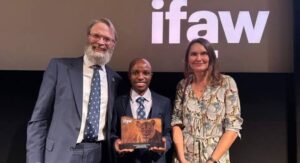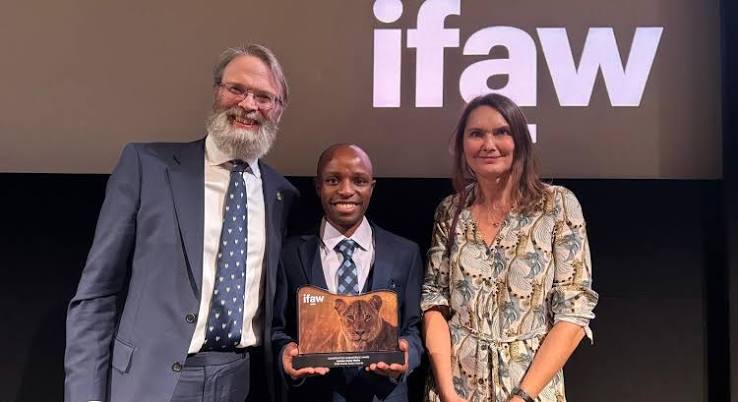
A Zimbabwean wildlife biologist won an international conservation award for helping rural communities protect their livestock while reducing conflict with lions around Hwange National Park. Liomba-Junior Mathe received the Conservation Coexistence Award at the 2026 Animal Action Awards organised by the International Fund for Animal Welfare (IFAW).
The ceremony took place at BAFTA in London last week. Mathe’s work focuses on reducing conflict between people and wildlife. His approach combines community engagement, early-warning systems and livestock enclosures designed to keep predators away from cattle and goats.
“This award may have my name on it, but I have never worked alone,” Mathe said. “There have always been people walking alongside me, communities, colleagues, mentors and conservationists who have shaped my journey. Everything I have learned has come from working with people and wildlife, listening, adapting and finding solutions together. This recognition belongs to them too.”
His work addresses a persistent challenge in conservation. Communities living near protected areas can lose livestock to predators. Such losses threaten household incomes and can lead to retaliatory killings of wildlife.
Hwange National Park is Zimbabwe’s largest protected area. It is home to lions and other large mammals. Communities living around the park depend on livestock and farming for their livelihoods.
In communities like Hwange, a lion attack can mean losing an important source of income. Conservationists have sought ways to protect both wildlife and the people who live alongside it. Mathe has promoted an approach that places communities at the centre of conservation efforts.
“We need to involve the communities that bear the cost of living next to wildlife,” he said. “We should not consider them simply as beneficiaries; we should consider them as partners. Conservation works when we come to the table with communities, understand their challenges and work together to find solutions.”
Mathe spent 11 years working with the University of Oxford’s Wildlife Conservation Research Unit, known as WildCRU, through its Trans-Kalahari Predator Programme in Hwange. He progressed from field assistant to leading the Long Shields Lion Guardian Programme.
The programme uses several methods to reduce livestock losses. These include early-warning systems, non-lethal deterrents and predator-proof enclosures known as bomas. The mobile enclosures are designed to prevent lions from seeing livestock inside. They can also be moved between farming areas. Their use aims to reduce livestock attacks while helping farmers protect their animals without killing predators.
IFAW reported in October 2023 that the initiative was being implemented with the Zimbabwe Parks and Wildlife Management Authority and WildCRU in communities around Hwange and Tsholotsho. At the time, the partnership had installed 18 predator-proof bomas in selected villages bordering the national park.
IFAW also cited WildCRU findings showing reductions in livestock predation ranging from 50% to 90% in other parts of Hwange District where the enclosures had been deployed. The figures relate to specific areas and do not represent a district-wide reduction.
Explaining the principle behind the enclosures, Mathe said in an earlier statement published by IFAW.
“The concept behind the bomas is that predators do not have visual access to livestock when enclosed in the boma; hence, they cannot trigger stampeding of livestock out of the bomas.”
IFAW’s Zimbabwe country director, Alleta Nyahuye, said Mathe’s work reflected a conservation approach that recognises the needs of local communities.
“Liomba represents a generation of African conservation leaders who understand that protecting wildlife cannot come at the expense of people,” she said.
“His work starts by listening to communities and understanding what it means for a family to lose livestock and then finding practical solutions that protect livelihoods while keeping lions alive.”
Mathe grew up in Hwange, near the national park. His interest in wildlife began after a primary school visit to Hwange National Park. He later graduated with first-class honours in Biological Sciences from Midlands State University. In 2016, he received a Recanati-Kaplan scholarship to study International Wildlife Conservation Practice through Oxford University’s WildCRU.
His work has also involved cheetahs and hyenas, protected-area management, landscape connectivity and community engagement. Mathe has estimated that he trained about 150 rangers and community guardians in approaches to managing human-wildlife conflict.
The Conservation Coexistence Award was among seven honours presented at the 2026 Animal Action Awards. Other recipients included Brazilian biologist Flávia Miranda, recognised for her work with anteaters, armadillos and sloths, and marine scientist Rima Jabado, honoured for her work on shark and ray conservation.
The organisation said winners were selected from public nominations. IFAW president and chief executive Azzedine Downes said the award recipients shared a commitment to improving outcomes for animals and the communities living alongside them.