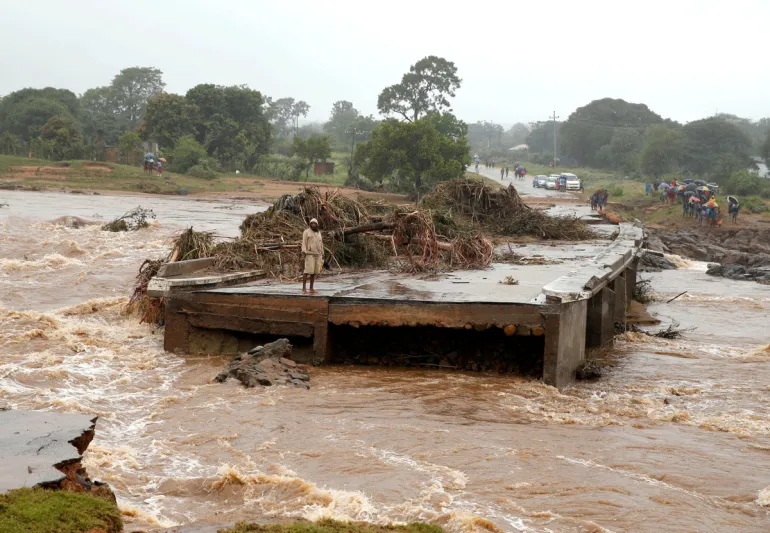
A man standing on the edge of the collapsed Umvumvu River bridge in Chimanimani, Zimbabwe, following the devastation caused by Cyclone Idai in March 2019. Photo Credit - Philimon Bulawayo/Reuters
Cyclone Idai, which struck Zimbabwe, Mozambique and Malawi in 2019, exposed the devastating cost of extreme weather in southern Africa. But the disaster also revealed another challenge facing vulnerable countries. These countries face difficulties in finding the money to rebuild while meeting existing financial obligations.
According to the United Nations Economic Commission for Africa, the three countries needed more than US$4 billion for recovery and reconstruction after the cyclone. Zimbabwe alone required an estimated US$600 million to US$700 million.
Seven years later, the relationship between climate disasters and public debt is becoming an increasingly urgent concern for Zimbabwe, where limited access to affordable international finance threatens efforts to prepare for a changing climate.
At a virtual media café organised by the Media for Environment, Science, Health and Agriculture (MESHA) and ActionAid International, Global Lead on Climate justice, Actionaid, Teresa Anderson argued that debt cancellation should be considered part of the global response to climate change.
“Debt is a climate issue; and climate is a debt issue,” Anderson said, describing how debt repayments can restrict governments’ ability to invest in climate adaptation, renewable energy and essential public services.
“Debt is a triple whammy for the climate, leaving countries exposed to impacts, preventing transitions, and expanding destructive industries. Debt is a major, but fixable- barrier to climate action. Action on debt could be one of the most impactful, and achievable climate solutions available,” said Teresa Anderson.
The argument is particularly relevant to Zimbabwe; whose debt remains a major obstacle to accessing international financing. The International Monetary Fund’s 2026 assessment put Zimbabwe’s public and publicly guaranteed debt at about US$22.8 billion at the end of 2025, with external debt estimated at US$15.2 billion.
The country also had approximately US$7.7 billion in arrears to official external creditors. The IMF considers the country’s debt unsustainable and in distress, complicating its efforts to secure new financing.
“This leaves the government facing competing demands; servicing or resolving existing debt, investing in economic recovery and finding resources to protect communities from increasingly severe climate impacts,” said Charmaine Kuriga, an economist and green governance expert.
The consequences are visible in the energy sector.
Zimbabwe’s Kariba South hydropower station, with an installed capacity of 1,050 megawatts, is vulnerable to falling water levels. Drought associated with the El Niño weather phenomenon reduced generation, contributing to electricity shortages and increased reliance on other sources.
The Treasury’s 2024 annual review said low water levels at Kariba and the poor performance of older Hwange units had undermined electricity supply, increasing pressure on businesses and households.
At the same time, Zimbabwe has invested in coal-fired generation. The Treasury’s 2024 public debt bulletin lists a US$998 million China Exim Bank loan for Hwange Units 7 and 8, which added 600MW to the power station. The investment has increased generation capacity, but experts say, it also raises questions about how the country can balance immediate energy security needs with its climate commitments.
According to the Actionaid fourth annual How the Finance Flows report, it is cheaper to produce electricity through hydropower (USD 1 million per MW) compared to coal (USD 2.5 million per MW).
“The largest loan taken out by Zimbabwe for investment in future energy production has been USD 1 billion in order to expand the coal powered facilities in Hwange. Zimbabwe is also seeking more loans to expand extraction of oil and gas and invest in a sub-regional pipeline. It seems it is still easier to borrow money for fossil fuel extraction than it is for more sustainable renewable alternatives,” said the report.
Zimbabwe is not, however, without a climate response strategy.
Its Nationally Determined Contribution (NDC 3.0), submitted in 2025, identifies substantial financing requirements for both adaptation and emissions reduction. The country estimates that implementing its adaptation measures between 2023 and 2030 will require about US$10.31 billion, while its mitigation contribution is estimated to cost approximately US$19 billion. The figures highlight the scale of the financing challenge, particularly when public resources are constrained.
In May 2026, the government and the United Nations Development Programme launched a Green Climate Fund readiness project intended to strengthen climate resilience, improve low-emission development planning and help Zimbabwe access climate finance. The initiative includes developing a climate technology needs assessment, improving private-sector engagement and preparing bankable projects for climate financing.
But access to finance remains a critical issue. Countries with high debt burdens can struggle to attract affordable funding, while loans for climate projects may add to obligations that future generations will have to repay.
ActionAid’s 2026 report, Debt Fuels the Climate Crisis: How the Finance Flows, argues that climate-vulnerable countries are spending far more on debt repayments than on climate action. Its analysis found that debt repayments across the Global South were nearly 225 times the grant-based climate finance received from wealthier countries.
Data analysis by Debt Justice shows private creditors own 23% of sovereign debt in climate-vulnerable countries, earning 44% of debt repayments. The Global South is paying 225 times more in debt repayments than it receives in grant-based climate finance. Debt cancellation in climatevulnerable countries could pay for Unconditional NDCs six times over.
“These are global figures, not Zimbabwe-specific estimates, but they illustrate the wider imbalance facing developing countries,” Kuriga told The Besana Mail.
The consequences also have a gender dimension. When droughts and floods disrupt livelihoods, Anderson said, women and girls often shoulder additional responsibilities, including travelling longer distances to collect water and caring for affected households.
“Women and girls walk longer for water, skip meals, leave school, face gender-based violence. Gender-responsive services are cut. Women pick up the slack in care work when public services are cut,” said Teresa Anderson.
During her presentation Anderson said, there is another piece of the puzzle that has the potential to unlock climate action in the Global South.
“But you almost never hear it talked about as a climate issue. Debt Cancellation as a climate solution,” said Anderson.
Addressing the problem in Zimbabwe according to Kuriga will require more than calls for debt cancellation. She said, debt restructuring and arrears clearance could help restore access to affordable international financing, while climate grants and concessional funding could reduce the need to borrow for adaptation.
“Debt relief alone will not guarantee effective climate action. Governments must also demonstrate transparency, accountability and sound management of any resources released.”