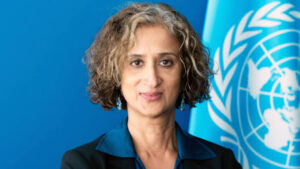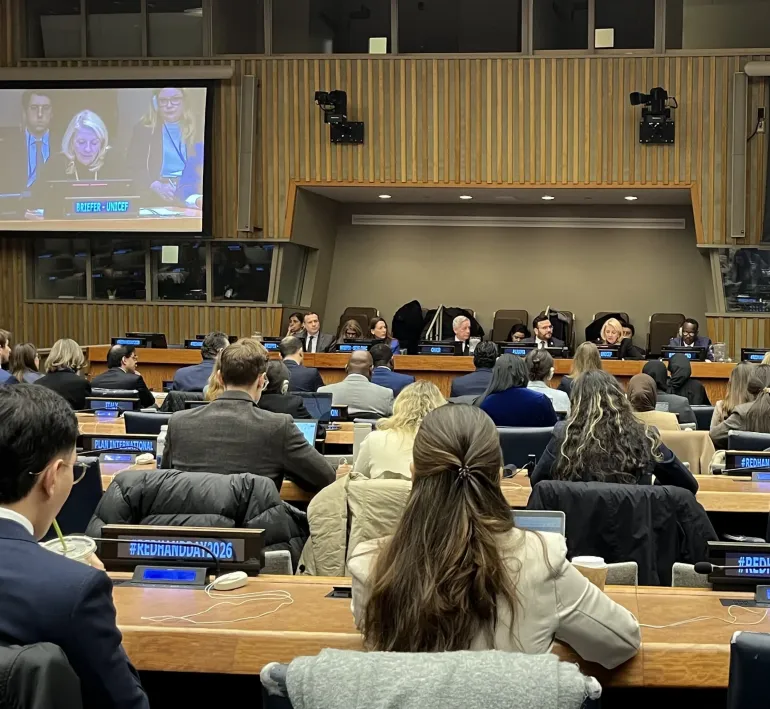
NEW YORK – On the occasion of Red Hand Day 2026, UNICEF Executive Director Catherine Russell addressed the United Nations Security Council, highlighting the urgent need to protect children from recruitment and abuse in armed conflicts.
Speaking at an Arria-formula meeting convened by Ambassador Alfaro de Alba and co-hosted by Greece, Austria, Japan, and Uruguay, Russell stressed that safe education is a powerful tool to break cycles of violence.
“Hundreds of millions of children today live amid war and violence, and tens of thousands are killed or injured every year,” Russell told the Council. “Conflict deprives children of schooling, nutrition, and protective spaces, leaving them increasingly vulnerable to exploitation.”
Since 2005, the UN has verified more than 14,000 attacks on schools and over 3,000 cases of military use of educational facilities—nearly two attacks a day over the past two decades. The situation in Gaza has been catastrophic, with 97% of schools damaged or destroyed since 2023. Other countries, including the Democratic Republic of Congo, Myanmar, and Ukraine, have seen hundreds of schools looted, burned, or hit by shelling and airstrikes.
“These attacks are grave violations against children, striking at their safety, dignity, and future,” Russell said. She warned that children out of school face heightened risks of child labor, early marriage, trafficking, and recruitment into armed groups. Schools used by armed actors not only increase the risk of direct harm but also create environments where children are more likely to be exploited.
Russell emphasized that education is both lifesaving and life-changing. Access to safe, inclusive, and quality learning environments provides children with structure, psychosocial support, meals, and essential services, while reducing the likelihood of recruitment.
UNICEF’s approach combines accelerated learning for those who have missed school, teacher training, community engagement, mental health support, and reintegration programs for children formerly associated with armed groups.
A key part of UNICEF’s advocacy is the Safe Schools Declaration, which urges all Member States to protect schools from attack and military use. Russell called on governments to implement the Declaration, integrate education into national action plans on children and armed conflict, ensure accountability for violations, and provide flexible financing for education in conflict zones.
“Safe education is more than a development investment—it is a vital protection measure and a cornerstone of sustainable peace,” Russell concluded. “By ensuring that children can learn in safety and dignity, we can finally help break cycles of violence.”