U.S. Ambassador to Zimbabwe, Pamela Tremont
Onita Sibanda
Leaders from various sectors and communities across Southern Africa convened this week in Victoria Falls, Zimbabwe, for the Southern Africa-U.S. Exchange Alumni Summit. The summit, themed “Regional Alumni Connections: Advancing Innovative Solutions to Global Challenges,” brought together participants from U.S. exchange programs across the region.
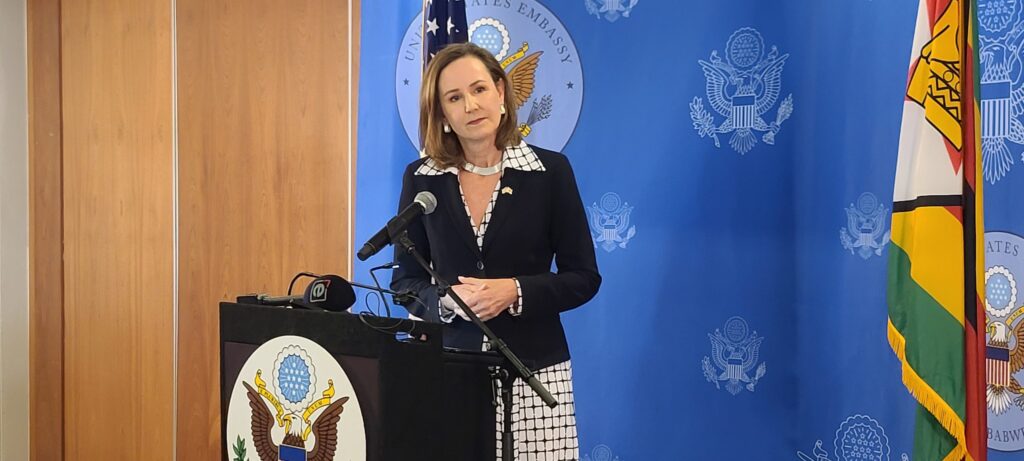
In her keynote address, U.S. Ambassador to Zimbabwe, Pamela Tremont, emphasised the importance of alumni exchange programs in fostering greater understanding and cooperation between the United States and Southern Africa.
“The most pressing challenges of our time do not recognize borders, and neither do the solutions,” Tremont said.
She highlighted the role of U.S. exchange alumni in driving positive change in their communities, noting that these exchanges have been a cornerstone of U.S. diplomacy, allowing individuals from diverse backgrounds to share ideas and build meaningful connections.
Alumni from various sectors are transforming economies and societies, creating jobs, driving economic development, and promoting social justice. The summit hosted over 100 U.S. exchange alumni from Angola, Botswana, Eswatini, Lesotho, Malawi, Mozambique, Namibia, South Africa, Zambia, and Zimbabwe.
Ambassador Tremont reiterated the United States’ commitment to supporting U.S. exchange alumni, investing in exchange programs, and sustaining diplomatic engagement across the region. She also stressed the power of relationships in strengthening both the United States and alumni networks.
Sharing a statement from the U.S. Secretary of State Marco Rubio, Tremont reinforced this message, stating:
“We need to ensure that we have an environment that’s conducive to creativity, boldness, and new ideas—one that recognizes the rapidly changing world in which we live. We need to stay ahead of it.”
The summit underscored the impact of alumni exchange programs in fostering regional connections and tackling global challenges. Ambassador Tremont encouraged participants to build on their networks:
“Make the most of your time here. Exchange contacts, share your challenges and successes, and continue strengthening your network.”
Entrepreneurial alumni are creating jobs and driving economic development in their communities. Many are exploring innovative ways to access capital, expand e-commerce, form international partnerships, and promote financial literacy. The U.S. Embassy in Harare recognised the work of education-focused alumni, who are expanding opportunities for the next generation and pioneering solutions to the food and energy crises.
The impact of these exchanges extends far beyond the summit, with U.S. exchange alumni continuing to drive positive change in their communities.
One of the leading U.S.-Africa exchange programs is the Mandela Washington Fellowship for Young African Leaders, the flagship initiative of the Young African Leaders Initiative (YALI). Since its establishment in 2014, the fellowship has provided nearly 7,200 young leaders from across Sub-Saharan Africa with academic and leadership training in the United States.
Last year, Zimbabwe’s Hozi Innovator Trust and an alumna from Eswatini partnered with the Jacobson Institute at the University of Iowa to lead a groundbreaking project. By offering entrepreneurial training to 500 up-and-coming company executives in both nations, the program achieved a significant milestone in alumni participation and cross-border cooperation.
Notable alumni in attendance included Gift Ostallos Siziba and Terrance “KwaTerry” Maphosa, among other influential young African leaders.