Photo Credit: US Embassy in Zimbabwe
Onita Sibanda
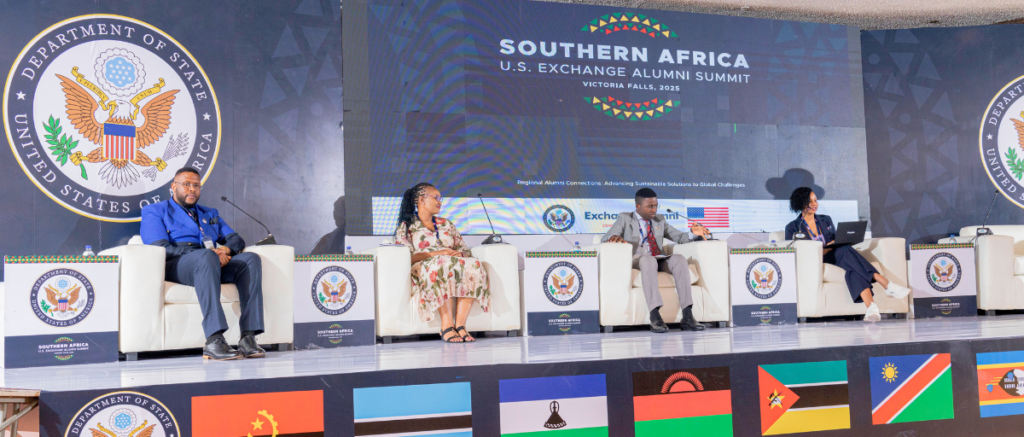
The recent Southern Africa–U.S. Exchange Alumni Summit brought together a dynamic group of alumni who are making a meaningful impact in their communities. These innovators, beneficiaries of exchange programs between Southern Africa and the United States, are spearheading positive change across various fields, from sustainable agriculture to social entrepreneurship.
The summit provided a platform for alumni to share their experiences, challenges, and successes. Many credited their exchange program experiences with broadening their perspectives, enhancing their skills, and inspiring them to develop innovative solutions to pressing regional challenges.
Mamolefe Petlane, a professional journalist and Executive Director of Sesotho Media and Development, has leveraged documentary film as a powerful tool for advocacy and empowerment in Lesotho.
“We use film to disseminate information on social and developmental issues. In today’s digital age, almost everyone has a gadget capable of capturing a story. It’s the most cost-effective way to produce documentaries without relying on expensive equipment,” says Petlane.
Beyond storytelling, she underscores the importance of financial literacy, emphasizing that communities need to understand money management to ensure long-term sustainability.
Zilongezyo Munzamba, founder of BaTonga Villa and Director of New Routes for Africa, has transformed a three-bedroom house that initially operated as an Airbnb into a thriving 15-bedroom tourism enterprise.
“We noticed a significant gap in tourism promotion. Natural attractions like the sand beach, hot springs, and even the rich local culture were not fully utilized to their advantage,” he explains.
Munzamba’s work goes beyond tourism, it is fostering economic empowerment by creating jobs, promoting cultural heritage, and providing a platform for the local community to showcase their traditions.
“At the summit, we connected with each other, discussed challenges, and developed innovative solutions,” he added.
His organization, New Routes for Africa, also engages youth in conservation efforts. Through training programs, young people learn to protect the environment and wildlife while generating income through ecotourism.
“We are promoting tourism in Binga as the only place with a sand beach in Zimbabwe. We also empower youth by involving them in conservation. We train them in environmental stewardship, helping them create sustainable sources of income,” Munzamba explains.
He also facilitates school conservation clubs, educating children on the importance of environmental preservation from an early age. By 2025, he aims to equip over 200 youths with the skills to generate income through ecotourism.
“It’s our responsibility as a community to drive development, whether it’s building a school, a bridge, or a youth center,” he adds.
The Southern Africa–U.S. Exchange Alumni Summit underscored the transformative power of alumni networks in fostering collaboration, knowledge sharing, and innovation.