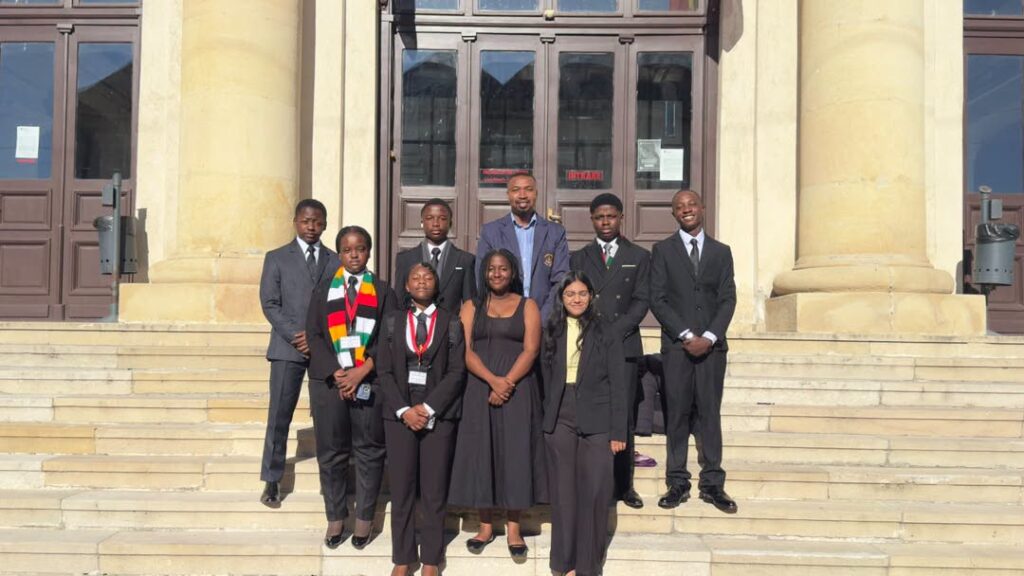
Eight Zimbabwean high school students have won the European Moot Court Championship in Romania, defeating France in the final. This comes after months of legal research, intensive training and preparation. The team, comprising four boys and four girls aged 13 to 16, defeated Azerbaijan in the semi-finals before securing the title in Câmpulung Muscel, Romania.
The competition required students to argue a simulated case involving international criminal law and humanitarian law, defending their legal positions before judges who could interrupt their presentations and challenge their reasoning. To two of the youngest competitors, Mukudzei Collen Junior Mharadzano and Sarah Arielle Msipa, both 13, the championship meant competing against students who were older and, in some cases, more experienced.
Advocate Nqobile Dube, founder and head coach of the Zimbabwe National Moot Court Team, said the achievement belonged to the students.
“This victory belongs first and foremost to the eight students. They represented Zimbabwe with extraordinary discipline, courage and intellectual maturity,” Dube said.
The team was selected from approximately 200 applicants drawn from schools across Zimbabwe, from Form One to Form Six. Candidates underwent virtual and in-person selection trials, with the in-person sessions held at Dominican Convent and adjudicated by members of the legal profession and law students from the University of Zimbabwe and Herbert Chitepo Law School.
The final team comprised captain Tinodaishe Cole Makwiranzou, 15, of St John’s College; deputy captain Amyra Jain, 15, of Hellenic Academy; Ziyanda Inzwirashe Madison Zawe, 15, and Giovanni Tawananyasha Nyatsambo, 16, both of Tynwald High School; Tafadzwa Samuel Mwagura, 15, and Mharadzano, both of Milestone College; Courtney Falees Joseph, 15, of Bulawayo Adventist School; and Msipa of Celebration International School.
The students prepared while continuing with their schoolwork and examinations. Because they were based in different parts of the country, much of their training took place online.
“There were many evenings when we trained from around 6pm until 10pm, sometimes while the students were also preparing for school examinations,” Dube said.
The simulated case required the students to develop prosecution and defence arguments and address complex questions, including attacks on civilians, environmental damage resulting from military action, perfidy and the jurisdiction of the International Criminal Court.
Dube said the students had to think quickly when judges challenged their submissions.
“They had to think on their feet under intense time pressure,” he said.
The achievement also came despite financial challenges associated with international competition. Telecommunications company NetOne provided a reported $12,000 in corporate sponsorship, while families contributed towards travel and other expenses. The students returned to Zimbabwe on Oct. 8 and were welcomed at Robert Gabriel Mugabe International Airport by government officials, parents, school representatives and supporters.
Taungana Ndoro, director of communications and advocacy in the Ministry of Primary and Secondary Education, said the government was proud of the team’s achievement.
“We are here as the Government of Zimbabwe and through the Ministry of Primary and Secondary Education. We are happy, and we are proud of the achievements that have been made by the Zimbabwe Moot Court,” Ndoro said.
The latest title adds to Zimbabwe’s record in international moot court competitions. In 2022, a Zimbabwean school team became the first African team to win the European Moot Court Championship, defeating the Netherlands in the final in Romania. The team also won a world championship that year.
Moot court competitions simulate legal proceedings and give students experience in legal research, argument construction, public speaking and responding to questions from judges. Dube said the latest victory showed that the country could develop young legal talent locally.
“We didn’t discover talent in Europe. We discovered it in Zimbabwe and gave it the training and platform to compete with the world,” he said.