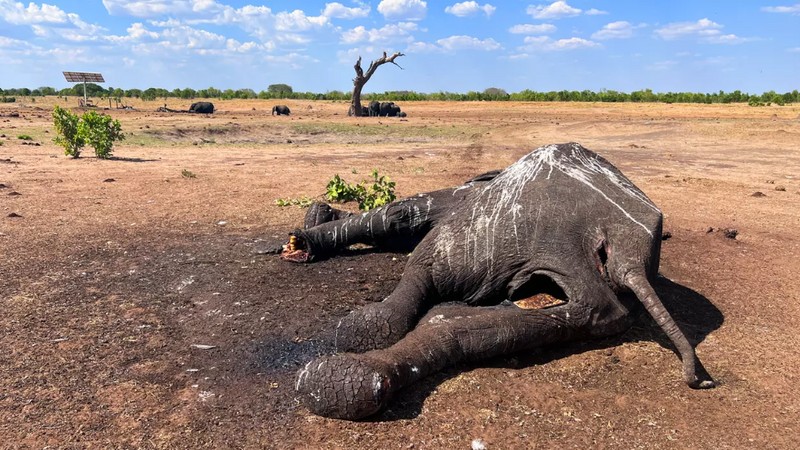
A dead elephant in Hwange National Budget
Carcasses of elephants dying of thirst are being found at waterholes in Zimbabwe’s biggest national park as a record drought goes on.
Hwange, Zimbabwe – At least 100 elephants have died of thirst in the last three months at the Hwange National Park, home to thousands of different wildlife species, according to data released on December 7 by the Zimbabwe Parks and Wildlife Management Authority (Zimparks).
The deaths were the outcome of drought across the southern African country, severely impacting the park which is a hub for the “big five” (Elephants, Lions, Buffaloes, Rhinoceros and Leopards).
In a statement by Zimparks, the actual number of deaths is yet to be fully ascertained as the agency continues its search for carcasses across the park which covers 14,651km2.
In Zimbabwe, the rainy season runs from November to March of the following year but the nation has not yet seen rain since the onset of November due to El Niño’s weather effects. And this could lead to a record drought compared to previous years, according to Munashe Mpala, a conservationist.
“Countrywide there are no rains, this is a drought. To worsen the situation, Hwange National Park is located under the agro-ecological region 4, it’s a dry region,” said Mpala.
“Due to a decrease in our surface water, we are depending more and more on artificial water. Elephant deaths are increasing because of their need for water,” said Daphine Madhlamoto, a Principal Ecologist at the Hwange National Park.
Mangaliso Ndlovu, minister of Environment, Climate Change and Wildlife said the government was concerned that climate change is taking a toll on the park.
“We are having serious challenges with water. The government will be working with other conservation partners, particularly the International Fund for Animal Welfare (IFAW), whose presence in Hwange National Park has greatly enhanced animal conservation through cooperation,” said Ndlovu.
The conservation projects include construction of more water sources to alleviate the drought effects in the park.
Zimbabwe is divided into 5 agro-ecological regions, the numbering is based on soil fertility and rainfall variability and as the number descends the conditions become extremely poor. Region 4 is characterized with low rains and high temperatures
Speaking to the media in September this year Tinashe Farawo, Zimparks Spokesperson, said Zimbabwe remains home to the second largest herd of elephants, after Botswana in the world.
The last countrywide census of elephants’ population in 2014 estimated between 76,000 and 93,000 elephants. Conservation groups African Wildlife Foundation and Painted Dogs Conservation concur that lately elephant population has increased to approximately 100 000. The park, spanning 14,600 square kilometers, is home to half of Zimbabwe’s elephant population.
The World Wildlife Fund and African Wildlife Foundation (AWF) have classified water scarcity as one of the serious threats facing wildlife in the world. While AWF speaking on climate adaptation said these animals sometimes would go down to the Zambezi valley during the dry season and have water and food.
“Unfortunately, the Zambezi valley falls under the United Nations Intergovernmental Panel on Climate Change (IPCC) Regional Climate Model , which shows that the mean annual temperature has warmed by 0.7 degree celcius between 1901 and 2014 and will increase to 1.2 degrees celsius by 2039, while precipitation will decline by between 3% and 12% by 2040,” said AWF
Due to the lack of natural water streams, the park is dependent on pumps, boreholes, and artificial water sources. As the El Nino weather continues, the water levels are dropping dramatically and impacting wildlife within it, park authorities say
The 104 solar-powered boreholes strewn across the shrubs and woodlands provide water to the park’s lifeblood. An adult elephant needs 200 litres (53 gallons) of water each day according to Daphine Madhlamoto, Zimparks’ principal ecologist at the park.
“The solar-powered boreholes are unable to meet the water demand,” said Madhlamoto.
Al Jazeera saw the remains of numerous elephants close to watering holes while visiting the park. According to park officials, more elephants have perished in the jungle, making lions and vultures easy prey.
According to Tinashe Farawo, a spokesman for Zimparks, the water table is dropping. It is an expensive operation for the authorities to drill some of these boreholes, which reach depths of 100 to 120 meters.
Survivors crossing borders
Seasonal migration is not unusual, but this year it began considerably early because of the dry circumstances in Hwange National Park. According to Zimparks, elephant populations have migrated into neighbouring Botswana, forcing animals to trek great distances in search of food and water.
Hwange National Park borders Zambia and Botswana. The park also shares common international borders with Namibia and Angola along the Okavango and Zambezi River basins which forms the Kavango Zambezi Transfrontier Conservation Area.
More than 400 bird species and over 100 mammal species can be found in the park, including 19 large herbivores and 8 large carnivores.
“To avoid the current drought conditions in the Hwange National Park, elephants and other animals like buffalos, wildebeests, and zebras are leaving Hwange National Park in their droves and crossing into Botswana,” stated Farawo.
He clarified, “By August, most water sources had dried up, which is unusual since this happens after October through November, when it’s the hottest.”
Section head
Over 200 elephants and other wildlife species perished in the country’s parks in 2019 as a result of the harsh drought conditions.
Zimparks and conservation partners in late 2022 translocated more than 2,500 wild animals from the arid southern parts of the country to the north, where conditions were better as the ravages of climate change replaced poaching as the biggest threat to wildlife.
In one of the largest live animal capture and translocation operations in southern Africa, approximately 400 elephants, 2,000 impalas, 70 giraffes, 50 buffaloes, 50 wildebeest, 50 zebras, 50 elands, 10 lions, and a pack of 10 wild dogs are among the animals being moved from Zimbabwe’s Save Valley Conservancy to three conservancies in the north – Sapi, Matusadonha, and Chizarira.
Speaking to Aljazeera Mpala said this year’s drought is threatening wildlife compared to the one in 2019.
“Numbers of dead elephants could not have reached there yet compared to 2019, but the parks officials are still searching out. Numbers can triple, we will watch the space. Sadly, we haven’t heard any plans on translocation, maybe because El Nino is affecting the whole country, and there are no rains to talk about. Besides, translocation is an expensive and well-thought exercise,” explains Mpala.
Weather Forecast
According to the Meteorological Services Department (MSD) of Zimbabwe, the drought is predicted to last until 2024.
“Rainfall has decreased by some 20 percent, while frequency of droughts has increased from once a decade to about once every three years,” the department said in a statement released in September this year..
“While hot days have increased in frequency, the number of cold days has decreased,” states MSD, “there has been a 20 percent decline in rainfall and a three-year increase in the frequency of droughts from once every ten years.”
The UN World Meteorological Organization commented on El Nino, citing evidence from previous warm Tropical Pacific episodes supporting similar claims. The organization predicted that this event will have significant and wide-ranging effects on weather patterns through much of the tropics and beyond, at least until the end of 2023 and the first quarter of 2024.
“In some regions, this disruption is likely to have significant effects on natural ecosystems, economic activity, and communities.”
Timely discussions – COP 28
Conservationists claim that the deaths of several elephants in Hwange National Park should serve as a wake-up call for those negotiating at the ongoing COP28 in Dubai, United Arab Emirates.
The seasonal El Nino, which causes hotter, drier weather throughout the year, has been exacerbated by climate breakdown, scientists say.
The “COP” 28 conference of parties on climate change convened on November 30 and concluded on December 12. Climate change and environment ministers from across the globe convened and recommended that countries increase their efforts to conserve sinks and reservoirs in wildlife protected areas. The meeting acknowledged that climate change had a direct impact on wildlife conservation.
According to the Zimbabwe National Elephant Management Plan (2021-2025), the Zimbabwe Parks and Wildlife Management Authority, wants to maintain numbers/densities of elephants at levels that do not adversely impact on biodiversity conservation goals while contributing to economically viable and sustainable wildlife-based land uses in Zimbabwe.