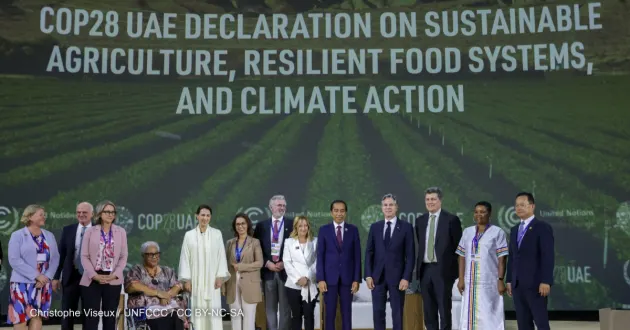
COP - Leaders committed to transform food systems in Dubai, UAE.
There is a worrying chance that significant food-related measures won’t be part of the final agreement following a global stocktake. Zimbabwean market gardeners, however, are optimistic.
BALANCED DIET COP
Lupane, Zimbabwe – In Lupane, farmers are grappling with the challenge of meeting market demand due to the absence of rains in the vicinity. For these farmers, the concern goes beyond financial gain, with an emphasis on the health advantages of their produce in light of climate change.
In Matabeleland North, northwest of Zimbabwe, approximately 9940.2 kilometers from Lupane, leaders convened in Dubai to deliberate on global concerns. Countries have pledged to cut carbon emissions by 1.5 degrees Celsius since the 2015 Paris Agreement. Portia Chimanga (36) in Lupane is one of the young farmers’ hopeful about the outcome of COP 28.
The principal objective of the Paris Agreement, which was ratified by 196 Parties at COP21 in Paris on December 12, 2015, and has been in effect since November 4, 2016, is to keep the average global temperature increase well below 2°C and to aim for no more than 1.5°C over pre-industrial levels.
Portia, a market gardener in Zimbabwe, confronts difficulties since water supply varies with the seasons, despite the pressing need to cut greenhouse gas emissions. Portia, a wellness advocate, explains how climate change is disrupting people’s health.
“Surprisingly we maintain a clean environment here, no emissions. But, we are the most affected. I was interested in the conference talking about health issues around climate change. As a wellness activist, I believe in nutrition health, which is facing disruption due to climate change,” notes Pauline.
COP 28 was important as Zimbabwe waits for rains. Market gardening faces dire repercussions as a result of El Niño, according to the MET department, and water bodies being affected by a lack of rain. The COP28 Declaration on Resilient Food Systems, Sustainable Agriculture, and Climate Action was a landmark event that emphasised the sustainability of food systems and urged leaders to support it.
By emphasising the sustainability of food systems, the COP made history and became the first meeting to highlight their critical role in accomplishing the objectives of the Paris Agreement. Through its COP28 Food Systems and Agriculture Agenda, the UAE played a significant role in setting aside December 10 as a day for in-depth talks on food, agriculture, and water. With a focus on climate action, sustainable agriculture, and resilient food systems, the UAE urged world leaders to support the Declaration.
Pauline’s coworker, Elliot Mafa (33), used to bring his produce to the market twice a week. Due of capacity limitations, which were mostly caused by problems with the water supply, he was forced to lower the frequency to once per week as of late.
The practice of marketing gardening plays a crucial role in the health ecosystem, providing fresh vegetables and fruits to the market. Because of their important function in communities, these gardens are also known as nutrition gardens in some rural areas.
Despite this significance, COP28’s Food, Agriculture, and Water Day saw a number of noteworthy announcements. Stakeholders and individual governments demonstrated their dedication to restoring vital freshwater habitats and implementing significant food-based climate action. Experts in food security, however, stated that there is still disagreement about a revised Global Stocktake draft.
Joao Campari, the World Wide Fund’s (WWF) Global Food Practice Leader, said he was grateful for COP 28 and praised the conference for making food systems reform a key priority.
He remarked, “What began as a few voices on the margins of COPs just a couple of years ago has now crescendoed to a summit-wide day of pledges and announcements.” Campari highlighted the significance of the Emirates Declaration on Sustainable Agriculture, Resilient Food Systems, and Climate Action, which garnered signatures from more than 150 countries.
WWF welcomed the commitments made and extended special acknowledgment to the governments of Brazil, Norway, Sierra Leone, Cambodia, and Rwanda for their initiative in launching the Alliance of Champions for Food Systems Transformation.
Local nutritionist Wonder Fundulani emphasised the need to address climate change immediately, especially in light of the next pandemic’s unexpected nature.
“Diseases in various forms are emerging constantly. Unfortunately, zoonotic diseases have proven to be devastating and destructive, affecting both lives and progress. One solution is to strive for a healthy environment that takes care of both people and animals,” said Fundulani.
Highlighting the critical role of peri-urban agriculture in sustaining food security and livelihoods in urban communities, Fundulani expressed concern that, despite its importance, peri-urban agriculture has not received sufficient attention in relation to its interface with climate change in Zimbabwe.
Farmers are adjusting in a number of ways when they see changes like decreased precipitation, warmer air temperatures, and declining borehole yields. These include replanting, nighttime plant watering, leasing animal space on farms with larger water sources, and buying extra feed for animals.
“Climate change threatens to reverse the global gains made in human well-being over the years including in food security and nutrition and sustainable development in general,” said Mafa.
During COP 28, negotiators emphasised the necessity for immediate action to understand the effects of climate change on agricultural systems and how these systems are reacting at local scales.
The conference’s discussions acknowledged the vital role that peri-urban agriculture plays in maintaining livelihoods and food security as well as in creating resilient urban communities.
Wonder Fundulani stressed the importance of understanding the peri-urban context, which has often been overlooked in scientific literature, despite its immense contribution to food security and the well-being of urban populations.
Globally, climate projections suggest that the effects of climate change will increase food insecurity in emerging nations.