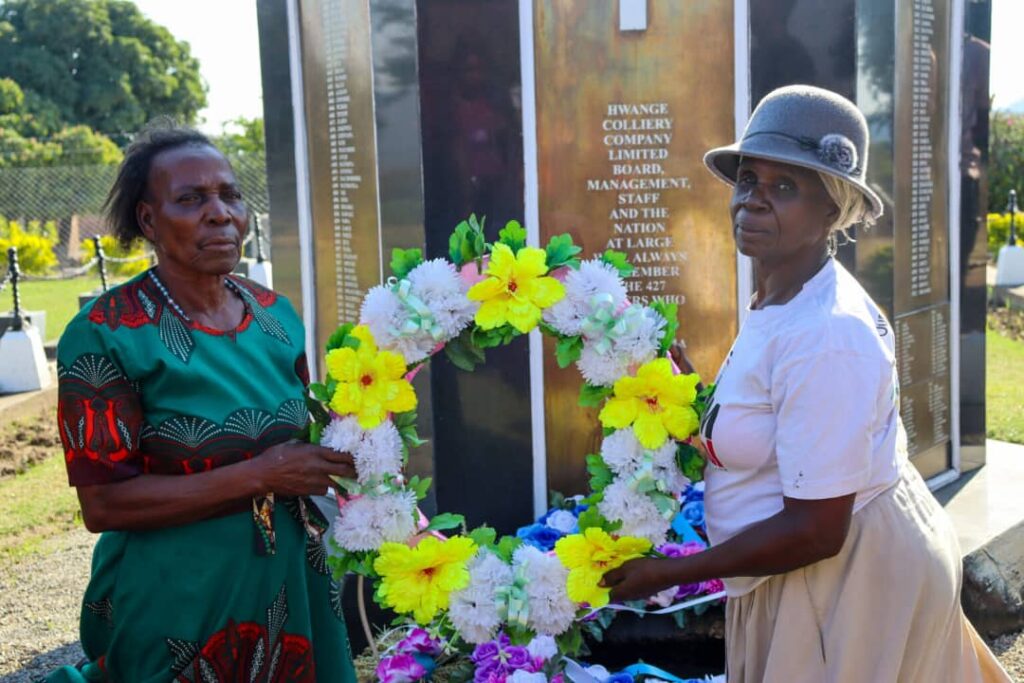
Surviving widows holding a wreath at the Kamandama Memorial site
HWANGE – Communities in Hwange every year gather to commemorate the victims of the Kamandama Mine Disaster, Zimbabwe’s worst mining tragedy, with calls for stronger workplace safety standards. This year, stakeholders called for better support for affected families, and continued remembrance of the 427 miners who lost their lives in the underground explosion of June 6, 1972.
The commemorations, held at the Kamandama Memorial Site in Hwange, brought together traditional leaders, mining executives, workers, widows, descendants of the deceased miners, and members of the public. The event marked 54 years since the disaster that occurred at Wankie Colliery No. 2 Mine, now part of the operations of Hwange Colliery Company Limited. The tragedy remains one of the deadliest mining accidents in African history.
Historical records show that a methane gas ignition triggered a series of underground explosions on June 6, 1972, killing 427 miners. The blast was reportedly heard several kilometers away and led to significant reforms in mine safety regulations in Zimbabwe and across the region.
During this year’s commemorations, attendees observed moments of silence and reflected on the sacrifices made by the miners whose labour helped build Zimbabwe’s coal mining industry. Similar commemorations have been held annually on June 6, a date recognised by labor organisations and mining stakeholders as an important reminder of workplace safety.
The guest of honour, Matabeleland Minister of State and Provincial Affairs, Richard Moyo, said, while mining remains a key pillar of Zimbabwe’s economy, economic progress must never come at the expense of worker safety.”
“Government remains committed to ensuring that our mining sector operates under robust safety standards, effective regulatory frameworks and responsible operational practices,” said Minister Moyo in a statement.
Speaking about the Kamandama disaster, traditional leader Chief Whange emphasised the importance of maintaining high safety standards in mining operations and ensuring that companies remain vigilant against workplace hazards.
“While progress has been made since the 1972 tragedy, there is no room for complacency in protecting workers,” said Chief Whange.
Mining executives have also used the commemorations to reaffirm commitments to worker safety. Hwange Colliery Holdings Chief Executive Officer William Gambiza stated that the company continues to pursue a “zero-harm” approach through improved safety systems, training, and international safety standards certification.
For many families, however, the commemorations are about more than remembrance. Widows and descendants of the victims continue to raise concerns about welfare and support decades after the disaster. Interviews conducted over recent years, and to this date, with surviving widows reveal feelings of neglect and calls for greater assistance from both the company and government authorities. Some families say the annual commemorations, while important, should be accompanied by long-term social and economic support.
“The day remains a painful reminder of the loss we suffered, and to think of our loved ones who never returned from work,” said one widow.
Others have argued that the miners’ sacrifices should continue to inspire efforts to improve living conditions for surviving dependents. Labour unions and civil society organisations have echoed those concerns. In recent years, organisations such as the Zimbabwe Congress of Trade Unions and the Centre for Natural Resource Governance have used the occasion to call for accountability and safer mining practices.
According to the Centre for Natural Resource Governance, the Kamandama tragedy remains a symbol of the human cost of unsafe mining practices and a reminder of the need for continuous vigilance in an industry that remains one of Zimbabwe’s key economic sectors. The organisation has also highlighted the importance of protecting workers’ rights and ensuring that mining companies comply with safety regulations.
Mining safety advocates argue that the lessons of Kamandama remain relevant today. Zimbabwe continues to record mining-related accidents, particularly in small-scale and informal operations, prompting renewed discussions about safety training, regulatory enforcement and emergency preparedness.
Zimbabwe Diamond and Allied Minerals Workers Union (ZDAMWU) general secretary Justice Chinhema called for safer workplaces and worker protection.
“For the past 54 years, these widows have carried the heavy burden as a result of the tragedy. We call all stakeholders to work together and achieve safe mining (paraphrased),” said Chinhema.
Community members attending the memorial stressed the importance of preserving the history of the disaster for younger generations. Many noted that while more than five decades have passed since the explosion, the impact continues to be felt in Hwange and beyond.
The annual observance has also generated calls for broader national recognition of the tragedy. Some labour leaders and legislators have previously proposed that June 6 be given greater national prominence as a day dedicated to workplace safety awareness and remembrance of workers who have died in the line of duty.