Zimbabwean President Emmerson Mnangagwa used his annual State of the Nation Address to highlight what he described as gains in economic stability, agriculture, energy and infrastructure. He also outlined a legislative agenda that includes changes to health care, drug enforcement, electoral law and firearms regulation.
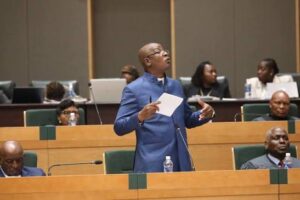
Addressing a joint sitting of Parliament, Mnangagwa said his government had consolidated economic stability and that inflation had fallen to single-digit levels since January.
“Zimbabwe is open for business,” Mnangagwa told lawmakers at the New Parliament Building in Mt Hampden.
He said foreign currency inflows had reached $10.7 billion in the first six months of 2026 and were expected to approach $20 billion by the end of the year. Mnangagwa also pointed to economic growth, saying the country’s gross domestic product was expected to grow 8.3%, with agriculture accounting for 2.2 percentage points of that expansion after the sector grew 27.9%.
The figures were presented as evidence of progress under the government’s economic program, although the address largely focused on government data and achievements rather than independently assessing their effect on households and businesses. Agriculture featured prominently in the speech, with Mnangagwa linking higher production to Zimbabwe’s broader industrialization ambitions.
He said the government wanted more agricultural products processed locally instead of being exported as raw materials, with the aim of increasing domestic manufacturing and creating jobs along the value chain. The government has also been pursuing special agro-processing zones in the country’s 10 provinces.
Energy and infrastructure were another major focus. Mnangagwa said frequent power cuts were now a thing of the past, attributing improved electricity supplies to generation from the Kariba and Hwange power stations, independent power producers, captive power plants, rooftop solar and net-metering. He also said the government was accelerating rural electrification through grid extensions and mini-grids, with public institutions among the targets.
Transport infrastructure, particularly rail, was highlighted as part of Zimbabwe’s effort to strengthen regional trade links. In April, Zimbabwe and Zambia signed an agreement on a proposed 311-kilometer railway link between Kafue and Lion’s Den. The government is also rehabilitating a 614-kilometer railway line between Chicualacuala and Plumtree, with completion targeted for August 2027. The project forms part of a $12 billion tripartite agreement involving the railway administrations of Zimbabwe, Mozambique and Botswana, according to the president’s address.
Mnangagwa also pointed to the Presidential Title Deeds Programme, which is intended to formalize land and property ownership in urban and peri-urban areas. The government is simultaneously revising building regulations and developing harmonized building codes, he said.
On social policy, the president said Zimbabwe was strengthening support for vulnerable groups, including people with disabilities, while using skills data to help reskill and place Zimbabweans returning from South Africa. Zimbabwe is scheduled to host the African Union Skills Week in October, an event Mnangagwa said would help position the country as a centre for skills development.
Health and education were also included in the legislative program for the new parliamentary session. The National Healthcare Provision Bill is expected to be introduced in Parliament, with the government saying it is intended to strengthen health services and improve equitable access. A separate National Drug and Substance Abuse Control and Enforcement Agency Bill is also expected to address drug abuse through prevention, enforcement and coordination.
The government plans legislation on trafficking in persons, including measures aimed at protecting Zimbabweans from fraudulent overseas employment schemes.
“A responsive regulatory foundation is essential for sustainable water resources management, agricultural marketing and value chain development,” Mnangagwa said as he outlined proposed changes affecting water and agriculture.
The legislative agenda includes amendments to the Water Act, the Zimbabwe National Water Authority Act, the Tobacco Industry and Marketing Board Act and the Tobacco Research Board Act. Environmental legislation will also be revised, including the Forest Act and the Communal Land Forest Produce Act.
The president said the government would continue efforts to strengthen Zimbabwe’s education system. The Zimbabwe School Examinations Council Amendment Bill has been sent back to Parliament for reconsideration to ensure that it complies with constitutional requirements. The government is also seeking amendments to firearms legislation and plans to advance bills dealing with biological weapons, arms trade and nuclear weapons.
Veterans of Zimbabwe’s liberation war were another focus of the legislative program, with three amendment bills intended to address statutory benefits and issues involving war veterans, dependents and victims of the liberation struggle.
The speech also turned to Zimbabwe’s regional and international role. Zimbabwe is due to take up a non-permanent seat on the United Nations Security Council for the 2027-28 term in January. Mnangagwa said the country would approach the role according to its foreign policy principle of being “a friend to all and an enemy to none.”
Zimbabwe is also scheduled to host the 25th COMESA Heads of State and Government Summit in October, when it is expected to assume the chairmanship of the regional bloc. The government has increasingly presented regional infrastructure, trade and investment as central to its economic strategy, particularly as Zimbabwe seeks to benefit from its position between southern and central African markets.
The president said progress toward the government’s 2030 development targets remained the central objective.
“With less than four years remaining until 2030, we have achieved unprecedented milestones,” Mnangagwa said.
He acknowledged, however, that “much work lies ahead,” calling on lawmakers, businesses, women, young people, traditional leaders and communities to participate in the country’s development. The address came as Zimbabwe prepares for another parliamentary session focused on implementing the government’s policy program and making consequential legal changes.
Among the proposed measures is an amendment to the Electoral Act following the enactment of Constitutional Amendment Act No. 3. Mnangagwa said the government would continue to emphasize rule of law, access to justice, constitutionalism, good governance and public accountability.